| Authors: | Rani Mary Joy, Miquel Cherta Garrido, Omar J.Y. Harb, Hendrik Jeuris, Rozita Rouzbahani, Jan D’Haen, Stephane Clemmen, Dries Van Thourhout, Danny E.P. Vanpoucke, Paulius Pobedinskas, and Ken Haenen |
| Journal: | ACS Materials Lett. XX, YY (2025) |
| doi: | 10.1021/acsmaterialslett.5c01218 |
| IF(2023): | 8.7 |
| export: | bibtex |
| pdf: | <ACSMaterialsLett_XX> |
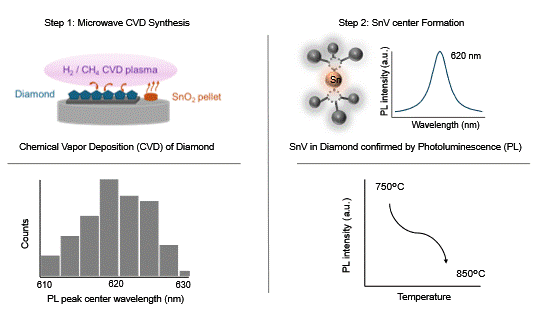 |
| Graphical Abstract: Experimental observation of SnV zero-phonon-lines in diamond. |
Abstract
Group IV color centers in diamond are promising single-photon emitters for quantum information processing and networking. Among them, the tin-vacancy (SnV) center stands out due to its long spin coherence times at cryogenic temperatures above 1 K. While SnV centers have been realized using various fabrication routes, their in situ formation via microwave plasma-enhanced chemical vapor deposition (MW PE CVD) remains relatively unexplored. In this study, SnV centers, identified by a zero-phonon line (ZPL) near 620 nm, were synthesized in nanocrystalline diamond and free-standing microcrystalline diamond using tin oxide (SnO2) as a dopant source at substrate temperatures of 750°C and 850°C. Photoluminescence measurements reveal that lowering the substrate temperature enhances both the ZPL intensity and spatial uniformity of SnV centers. These results highlight substrate temperature as a key parameter for controlling SnV incorporation during MW PE CVD growth and provide insights into optimizing fabrication strategies for diamond-based quantum technologies.