Category: 2026
| Authors: |
Brent Motmans, Digvijay Ghogare, Thijs G.I. van Wijk, Joren Van Herck, Saba Heidarian, Pieter De Meyer, Berend Smit, An Hardy, and Danny E. P. Vanpoucke |
| Journal: |
Chem. Mater XX, YYY (2026) |
| doi: |
ZZ |
| IF(2025): |
7.1 |
| export: |
bibtex |
| pdf: |
<ChemMater_XX> <ArXiv> |
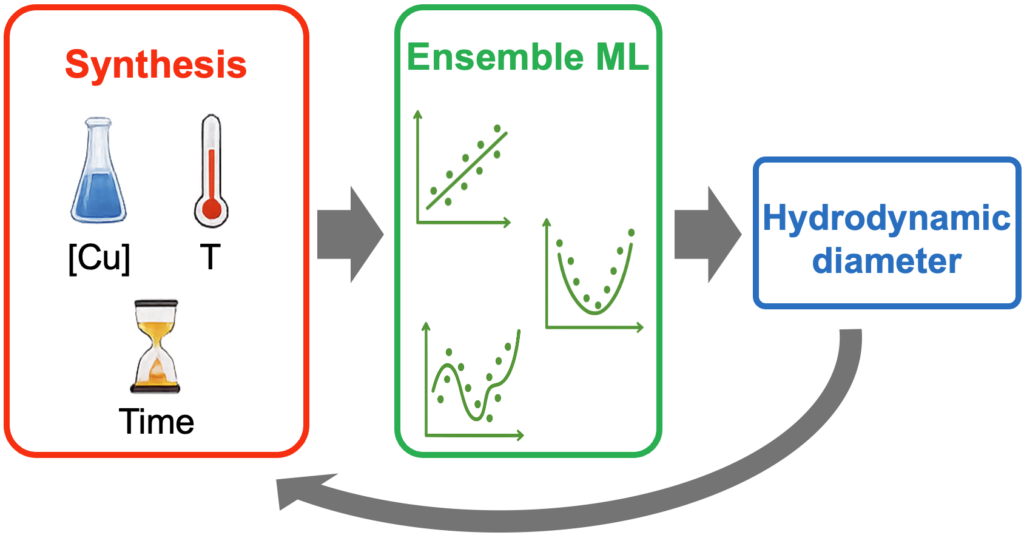 |
| Graphical Abstract: A machine learning approach to predict the hydrodynamic diameter of Cu Nanoparticles using a small data approach. |
Copper nanoparticles (Cu NPs) have a broad applicability, yet their synthesis is sensitive to subtle changes in reaction parameters. This sensitivity, combined with the time- and resource-intensive nature of experimental optimization, poses a major challenge in achieving reproducible and size-controlled synthesis. While Machine Learning (ML) shows promise in materials research, its application is often limited by scarcity of large high-quality experimental data sets. This study explores ML to predict the DLS-derived hydrodynamic diameter of Cu NPs from microwave-assisted polyol synthesis using a small data set of 25 in-house performed syntheses. Latin Hypercube Sampling is used to efficiently cover the parameter space while creating the experimental data set. Ensemble regression models successfully predict hydrodynamic diameters with good predictive performance given the limited dataset. Since quantitative regression requires a unique DLS-derived hydrodynamic diameter, the regression model is restricted to mono-modal DLS distributions, while a complementary classification model identifies synthesis conditions for which quantitative prediction is applicable. Using equivalent out-of-sample validation (OOB and LOOCV), the ML and DoE models showed comparable generalization (MAE -= 40.92 and 40.46 nm, respectively). The final ensemble model achieved an R2 of 0.74, an MAE of 23.81 nm, compared to an R2 of 0.60, an MAE of 33.54 nm for the DoE model, while retaining the complete synthesis parameter space, making it better suited for synthesis guidance. Additionally, classification models using both random forests and Large Language Models (LLMs) are evaluated to distinguish between large and small particles. These classification models exhibited only modest predictive performance, indicating that this small dataset is insufficient to fully exploit the capabilities of complex LLMs. Overall, this study demonstrates that carefully curated small data sets, paired with robust classical ML, can effectively support the synthesis of Cu NPs and highlights that for lab-scale studies, complex models like LLMs may offer limited benefits. The validation experiments further indicate the potential of ML guided synthesis to improve the efficiency of experimental optimization and reduce resource consumption.
Permanent link to this article: https://dannyvanpoucke.be/2026-paper_cunp_mlbrent-en/
| Authors: |
Stijn Lenaers, Stijn Lammar, Anurag Krishna, Brent Motmans, Bart Ruttens, Jan D’Hean, Tom Aernouts, Danny E.P. Vanpoucke, Koen Vandewal, Giuseppe Portale, Laurance Lutsen, Dirk Vanderzande, and Wouter T.M. Van Gompel |
| Journal: |
Sol. Energy Mater. Sol. Cells 307, 114662 (2026) |
| doi: |
10.1016/j.solmat.2026.114662 |
| IF(2025): |
6.6 |
| export: |
bibtex |
| pdf: |
<JSolMat> |
Inverted p-i-n perovskite solar cells (PSCs) have drastically increased in efficiency in recent years, partially due to the inclusion of self-assembling molecules (SAMs) as hole transporting materials (HTLs) and the addition of large organic ammonium salts as a passivating interlayer. In this study, the effect of halogen-functionalized carbazole-based ammonium salts as interlayers between the perovskite absorber and different HTLs is investigated. Fluorinated (F2-Cz), chlorinated (Cl2-Cz), and brominated (Br2-Cz) derivatives are synthesized and incorporated into p-i-n PSCs using NiOx, PTAA, 2PACz, and 4PAPyr as HTLs. All interlayers improve the open-circuit voltage (Voc), indicating effective defect passivation. Notably, a systematic increase in current density (Jsc) and overall PCE is observed across the halogen series from fluorine to bromine. Br2-Cz consistently delivered the highest performance across all tested HTLs, confirming its versatility as an interlayer that is compatible with different types of HTL. The highest power conversion efficiency of 20.9% (0.125 cm2) is achieved when applying the brominated carbazole derivative Br2-Cz on top of the in-house synthesized pyrene-based SAM 4PAPyr. These findings highlight the potential of targeted molecular engineering of interlayers to optimize solar cell performance.
Permanent link to this article: https://dannyvanpoucke.be/2026-paper_carbazole/
| Authors: |
Silviu Florin Acaru, Marc Comí, Panagiotis Falireas, Danny E. P. Vanpoucke, Richard Vendamme, and Katrien Bernaerts |
| Journal: |
Materials & Design 267, 116265 (2026) |
| doi: |
10.1016/j.matdes.2026.116265 |
| IF(2025): |
7.9 |
| export: |
bibtex |
| pdf: |
<Mat&Des_267> |
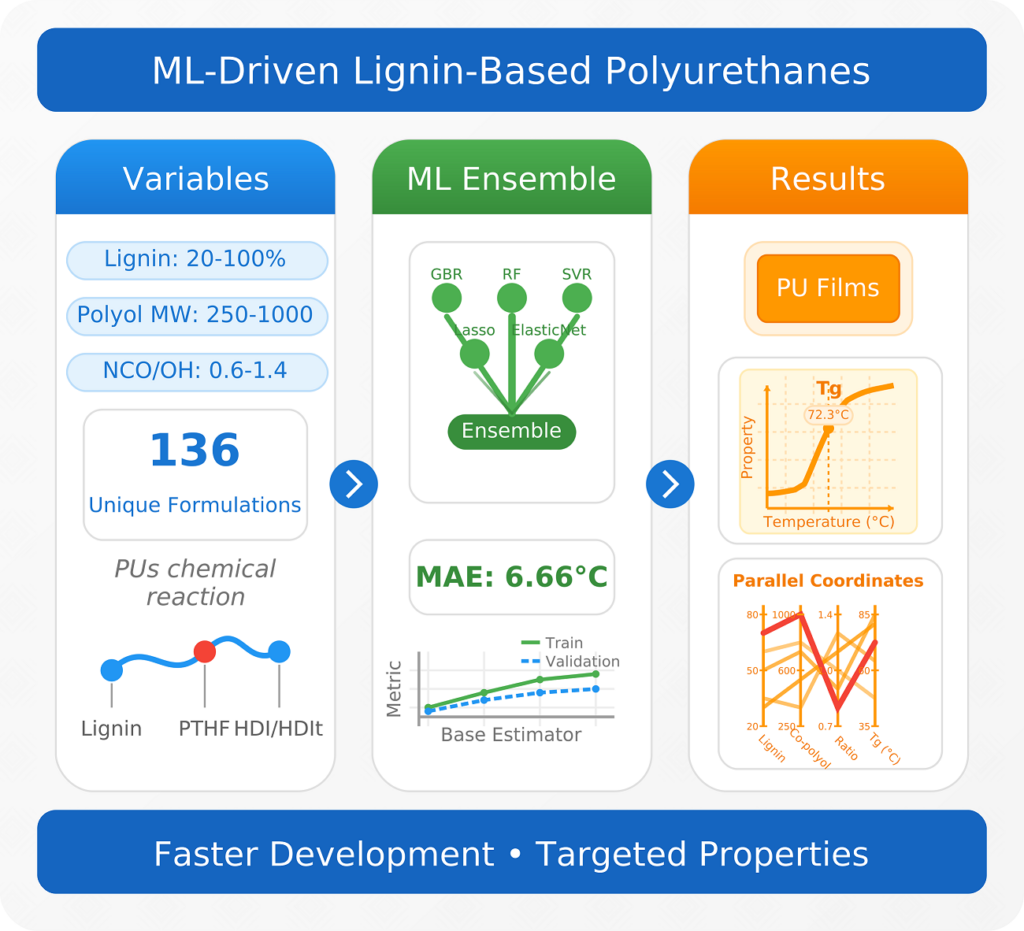 |
| Graphical Abstract: A machine learning ensemble accurately predicts glass transition temperatures for lignin-based polyurethanes within 6.66°C, despite being trained on a dataset of only 136 formulations. The model efficiently combines seven key features to overcome this data limitation. This optimized workflow generated over 4 million novel lignin-polyurethane formulations, with an intuitive interface accelerating the adoption of sustainable polyurethanes. |
Lignin-based polyurethanes (PUs) offer a compelling route towards sustainable material development, yet the challenge of designing chemical formulations with targeted properties, such as glass transition temperature (Tg), remains unresolved. In this work, we present a systematic approach, to explore key structural parameters—such as lignin content, polyol chain length, isocyanate functionality, and mixing ratios—across 136 unique formulations, creating a diverse dataset of ligninbased PUs. By harnessing this small dataset, we develop a machine learning (ML) ensemble model capable of accurately predicting Tg, with a mean absolute error of just 6.66°C on the validation set, surpassing the performance of conventional regression methods. Additionally, we enhance model interpretability by integrating advanced mapping techniques and employ an adaptive grid search algorithm to explore extrapolative scenarios. Our workflow, paired with a user-friendly interface, enables rapid discovery and optimization of formulations with desired properties. This study not only deepens the understanding of structure-property relationships in lignin-PUs but also provides a scalable ML-driven tool for designing sustainable materials with precision, highlighting the transformative potential of artificial intelligence in green chemistry and materials innovation.
Permanent link to this article: https://dannyvanpoucke.be/2026-paper_digiligninsylviu-en/
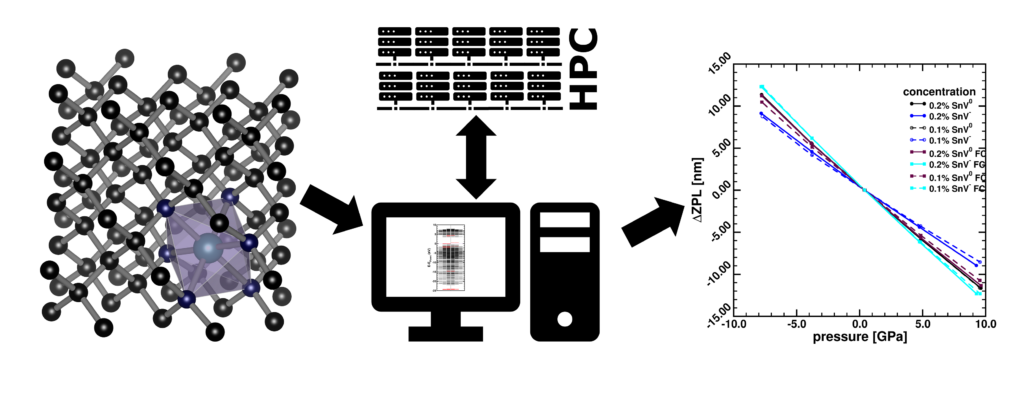 |
| Graphical Abstract: The SnV color center is modelled using first principle calculations to predict the zero-phonon-lines in diamond under hydrostatic strain. |
Among the group-IV vacancy color centers in diamond, the SnV holds promise for photonics based quantum applications. In this work, the Tin-Vacancy (SnV) zero-phonon line (ZPL) and its pressure coefficient are calculated using first principles approaches. The predicted absolute ZPL position is shown to be strongly influenced by the method and supercell size used. The results are therefore extrapolated to the dilute limit allowing for direct comparison with experiments. The importance of identifying the color-center related Kohn–Sham states is highlighted, as well as the shifting of these states due to electron excitations as well as supercell size and k-point position. In contrast to the absolute ZPL positions, the relative position of the SnV0 ZPL is consistently redshifted about 43 nm compared to the SnV– ZPL. In addition, the pressure coefficient is shown to be very robust over different methods, always resulting in a value of about 1.4 nm/GPa, for both SnV0 and SnV–. Finally, the computational accuracy and cost are put into perspective.
Permanent link to this article: https://dannyvanpoucke.be/2026-paper_snvcolorcenter/