

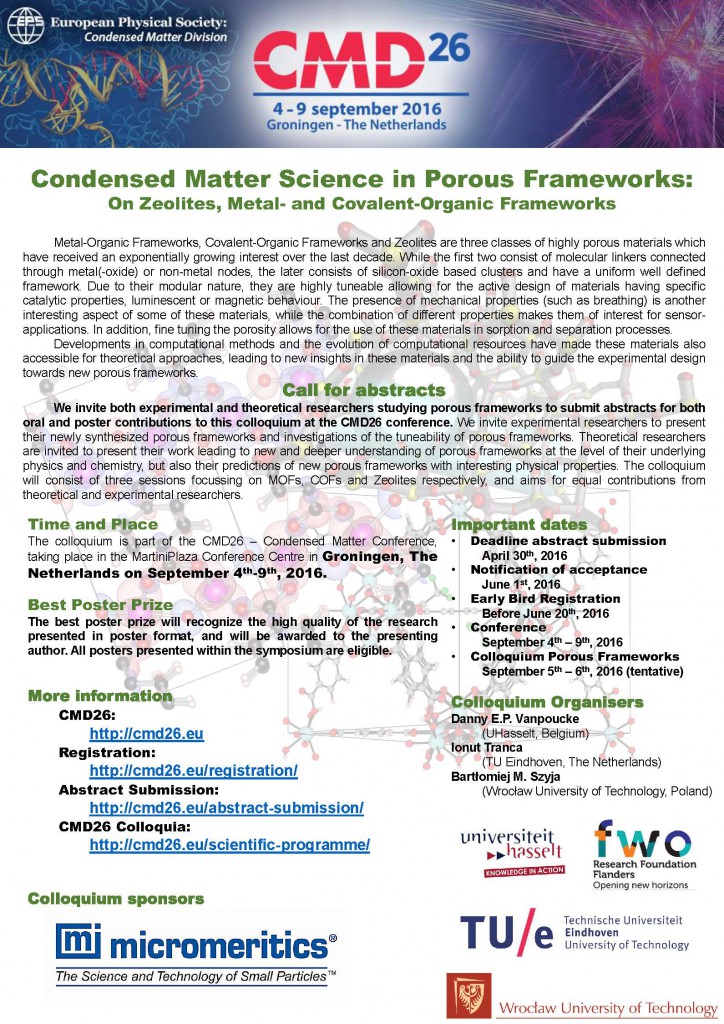
 Together with Ionut Tranca (TU Eindhoven, The Netherlands) and Bartłomiej Szyja (Wrocław University of Technology, Poland) I am organizing a colloquium “Condensed Matter Science in Porous Frameworks: On Zeolites, Metal- and Covalent-Organic Frameworks” which will take place during the 26th biannual Conference & Exhibition CMD26 – Condensed Matter in Groningen (September 4th – 9th, 2016). During our colloquium, we hope to bring together experimental and theoretical researchers working in the field of porous frameworks, providing them the opportunity to present and discuss their latest work and discoveries.
Zeolites, Metal-Organic Frameworks, and Covalent-Organic Frameworks are an interesting class of hybrid materials. They are situated at the boundary of research fields, with properties akin to both molecules and solids. In addition, their porosity puts them at the boundary between surfaces and bulk materials, while their modular nature provides a wealthy playground for materials design.
We invite you to submit your abstract for oral or poster contributions to our colloquium. Poster contributions participate in a Best Poster Prize competition.
The deadline for abstract submission is April 30th, 2016.
The extended deadline for abstract submission is May 14th, 2016.
CMD26 – Condensed Matter in Groningen is an international conference, organized by the Condensed Matter Division of the European Physical Society, covering all aspects of condensed matter physics, including soft condensed matter, biophysics, materials science, quantum physics and quantum simulators, low temperature physics, quantum fluids, strongly correlated materials, semiconductor physics, magnetism, surface and interface physics, electronic, optical and structural properties of materials. The scientific programme will consist of a series of plenary and semi-plenary talks and Mini-colloquia. Within each Mini-colloquium, there will be invited lectures, oral contributions and posters.
Feel free to distribute this call for abstracts and our flyer and we hope to see you in Groningen!