Characterization of Droplet Formation in Ultrasonic Spray Coating: Influence of ink formulation Using Phase Doppler Anemometry and Machine Learning

Authors: Pieter Verding, Danny E.P. Vanpoucke, Yunus T. Aksoy, Tobias Corthouts, Maria R. Vetrano, and Wim Deferme
Journal: Adv. Mater. Technol. XX, YY (2025)
doi: 10.1002/admt.202502104
IF(2025): 6.2
export: bibtex
pdf: <AdvMaterTechnol_XX>


graphical abstract ML spraycoating
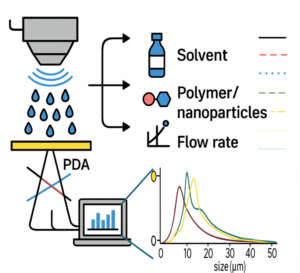
Graphical Abstract: This study explores how machine learning models, trained on small experimental datasets obtained via Phase Doppler Anemometry (PDA), can accurately predict droplet size (D₃₂) in ultrasonic spray coating (USSC). By capturing the influence of ink complexity (solvent, polymer, nanoparticles), power, and flow rate, the model enables precise droplet control paving the way for optimized coatings in advanced functional materials.

Abstract

This study examines droplet formation in ultrasonic spray coating (USSC) as a function of ink formulation (solvent, polymer, nanoparticles). First, acetone with polyvinylidene fluoride (PVDF) at concentrations from 0-4.5 wt% is used to examine the effect of polymer additions. Additionally, acetone-based SiO2 nanofluids (0-10 g/L), are explored. Finally, the combination of both polymer (PVDF) and nanoparticles (SiO2) in acetone is studied. Droplet sizes are measured using Phase Doppler Anemometry under varying atomization power and flow rates. Machine Learning (ML) algorithms are employed to develop droplet size models from key spray parameters, including atomization power, flow rate, polymer concentration, and nanoparticle concentration. The model shows significantly higher accuracy than existing empirical models. The model is further validated on IPA-based inks with polyethylenimine (PEIE) or ZnO nanoparticles, and on acetone–cellulose acetate formulations, confirming its robustness across diverse ink systems. In addition to revealing the influence of coating parameters on the droplet formation and distribution, obtained both via experimental validation and ML, this study demonstrates that ML can be effectively applied to small experimental datasets, offering a robust framework for optimizing droplet formation and understanding key spray parameters in USSC for complex, unexplored inks enabling novel coating applications.
Permanent link to this article: https://dannyvanpoucke.be/2025-paper_mldroplets_pieterverding-en/

Fabrication and Photoluminescence Studies of Tin-Vacancy Centers in Chemical Vapor Deposition Diamond

Authors: Rani Mary Joy, Miquel Cherta Garrido, Omar J.Y. Harb, Hendrik Jeuris, Rozita Rouzbahani, Jan D’Haen, Stephane Clemmen, Dries Van Thourhout, Danny E.P. Vanpoucke, Paulius Pobedinskas, and Ken Haenen
Journal: ACS Materials Lett. XX, YY (2025)
doi: 10.1021/acsmaterialslett.5c01218
IF(2023): 8.7
export: bibtex
pdf: <ACSMaterialsLett_XX>


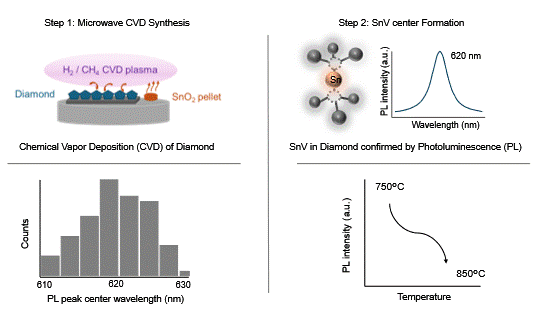
Graphical Abstract: Experimental observation of SnV zero-phonon-lines in diamond.

Abstract

Group IV color centers in diamond are promising single-photon emitters for quantum information processing and networking. Among them, the tin-vacancy (SnV) center stands out due to its long spin coherence times at cryogenic temperatures above 1 K. While SnV centers have been realized using various fabrication routes, their in situ formation via microwave plasma-enhanced chemical vapor deposition (MW PE CVD) remains relatively unexplored. In this study, SnV centers, identified by a zero-phonon line (ZPL) near 620 nm, were synthesized in nanocrystalline diamond and free-standing microcrystalline diamond using tin oxide (SnO2) as a dopant source at substrate temperatures of 750°C and 850°C. Photoluminescence measurements reveal that lowering the substrate temperature enhances both the ZPL intensity and spatial uniformity of SnV centers. These results highlight substrate temperature as a key parameter for controlling SnV incorporation during MW PE CVD growth and provide insights into optimizing fabrication strategies for diamond-based quantum technologies.

Permanent link to this article: https://dannyvanpoucke.be/2025-paper_snvfabrication_ranimjoy-en/

Quantifying water hydrogen bonding from the surface electrostatic potential at varying iso-density contours

Authors: Goedele Roos, Danny E.P. Vanpoucke, Ralf Blossey, Marc F. Lensink, and Jane S. Murray
Journal: J. Chem. Phys. 163, 114112 (2025)
doi: 10.1063/5.0268712
IF(2023): 3.1
export: bibtex
pdf: <JChemPhys_163>


Graphical abstract for Quantifying water hydrogen bonding from the surface electrostatic potential at varying iso-density contours. The figure shows the ESP of interacting water molecules, and water molecules interacting with protein fractions.
Graphical Abstract: The Electrostatic Potential of water in different situations. On the left two interacting water molecules are shown, while on the right a water molecule interacting with a protein model representation is shown.

Abstract

The electrostatic potential plotted on varying contours (VS) of the electron density guides us in the
understanding of how water interactions exactly take place. Water—H2O—is extremely well balanced, having a hydrogen VS,max and an oxygen VS,min of similar magnitude. As such, it has the capacity to donate and accept hydrogen bonds equally well. This has implications for the interactions that water molecules form, which are reviewed here, first in water–small molecule models and then in complex sites as lactose and its crystals and in protein–protein interfaces. Favorable and unfavorable interactions are evaluated from the electrostatic potential plotted on varying contours of the electronic density, allowing these interactions to be readily visualized. As such, with one calculation, all interactions can be analyzed by gradually looking deeper into the electron density envelope and finding the nearly touching contour. Its relation with interaction strength has the electrostatic potential to be used in scoring functions. When properly implemented, we expect this approach to be valuable in modeling and structure validation, avoiding tedious interaction strength calculations. Here, applied to water interactions in a variety of systems, we conclude that all water interactions take the same general form, with water behaving as a “neutral” agent, allowing its interaction partner to determine if it donates or accepts a hydrogen bond, or both, as determined by the highest possible interaction strength(s).

Permanent link to this article: https://dannyvanpoucke.be/2025-paper-wateresp-roos-en/

Special Issue: (R)Evolutions in the Integration of Artificial Intelligence and Machine Learning in Carbon-Based Materials Research

In light of the ever growing interest in AI and ML within the context of materials research, I’m guest editing a special issue together with Konstantin Klyukin from Auburn University. More information can be found on the flyer below.

(And yes the robot and diamond are AI generated, though it took some effort to get it to have the right number or arms, hold a diamond and look sideways at the same time. 😉


Permanent link to this article: https://dannyvanpoucke.be/special-issue-revolutions-in-the-integration-of-artificial-intelligence-and-machine-learning-in-carbon-based-materials-research/

QuATOMs group Logo

QuATOMs group logo using commandline green and black color scheme. Is shows the QuATOMs group name using organic letters, with a penguin mage standing at the right side.

With the planned arrival of 2 more PhD students to the group, it is finally time to make work of a group logo. QuATOMs is no longer the small solitary one-man-show, but has grown in the last three years to 5 eager PhDs and already 3 Post-docs have been part of the team.

The green-on-black colorscheme is inspired by the oldschool terminals, while the mage penguin of course combines a reference to Tux as well as the sometimes magical nature of computational materials research.

Permanent link to this article: https://dannyvanpoucke.be/quatoms-group-logo/

Summerschool Materiomics

For the second year in a row, we are organising a summerschool with the master materiomics program, oriented at  students in their second or third bachelor chemistry or physics. Within this summerschool the students are introduced into the various topics which play an important role in materials research. Today, as part of the quantum pillar, I had the pleasure to introduce the students into the world of computational research, with a focus on the application for quantum mechanical modelling. We learned for example, that it is practically impossible to store the wavefunction of a simple small molecule like benzene, it would require more great deal more than a mole of galaxies in mass to store it. With Density Functional Theory on the other hand, you can easily investigate it on a modern day laptop, as you only need the electron density.

Materiomics summerschool of 2025.


Permanent link to this article: https://dannyvanpoucke.be/summerschool-materiomics/

Highlighting python in Latex

Latex is one of the nicest tools for formatting documents, but also a rabbit hole when you want to get that one small feature to your liking. Many PhD students discover how months quickly vanish when trying to create the perfect template…and the situation does not improve with age :-). In a recent bout of rabbit chasing, I decided that I wanted to be able to have syntax highlighting for python available for a course syllabus I’m planning. Early searches looked hopefull as a simple to use package seems to be available for the job (and even suitable for other programing languages): minted. Which is promoted by the tutorial page on overleaf with regard to syntax highlighting. Installation is simple using the MikTex Console.(Though the latter first destroyed itself during an update, losing access to the Qtframework. But Once Miktex was reinstalled, installing minted is trivial.) Unfortunately, WinEdt had an issue which was sufficiently vaguely defined: it could be not installed, incorrectly installed, missing in the path, not accessible without a shell-escape, missing some environment variable…

After some searching (shell-escape switched on, added to the path, installing additional python support packages –>?seriously?) it became clear that the package was not installed entirely correctly. A .py script isn’t sufficient in windows, and an additional cmd script was needed (as well as python installation, which was a bit amazing as we are talking about latex, so there should be no need for python, but apparently minted is a python library, wrapped up for latex). So long story short, if you want to work with minted, you should add a small cmd script to the binary folder of your latex install (after “installing minted” using MikTex) which calls your python installation to execute the python script latexminted.py.

@echo off
"C:\Path\To\Python\Install\python.exe" "C:\Path\To\MikTex\Minted\latexminted.py" %*

Permanent link to this article: https://dannyvanpoucke.be/highlighting-python-in-latex/

MSc Materiomics defences & new QuATOMs members

MSc Thesis presentation of Brent Motmans and Eleonora Thomas (master materiomics students 2025). Both presenting applications of ML in materials research.

MSc Thesis presentation of Brent Motmans and Eleonora Thomas (master materiomics students 2025). Both presenting applications of ML in materials research: Machine Learning particle sizes using small lab-scale datasets (Brent) and development of Machine Learned Interatomic Potentials for the modelling of (the dynamics of) H-based defects in diamond.

Today we had the MSc presentations of the master Materiomics. The culmination of two year of hard study and intens research activities resulting in a final master thesis paper. This year the QuATOMs group hosted two MSc students: Brent Motmans and Eleonora Thomas. Brent Motmans performed his research in a collaboration between the QuATOMs and DESINe groups, and investigated the application of small data machine learning for the prediction of the particle size of Cu nanoparticles. His study shows that even with a dataset of less than 20 samples a reasonable 6 feature model can be created. As in previous research, he found that standard hyperparameter tuning fails, but human intervention can resolve this issue. Eleonora Thomas on the other hand introduced Machine Learned Interatomic Potentials (MLIPs) into the group. By investigating different in literature available MLIPs, she pinpointed strengths and weaknesses of the different models, as well as the technical needs for persuing such research further in our group. As collatoral, she was able to generate a model for H diffusion in diamond, with an MAE for the total energy of <10meV/atom, competing with models like google deep-mind’s GNoME.

While working on their MSc thesis, Brent and Eleonora also applied for fellowship funding for a PhD position, and we are happy to announce both Brent and Eleonora won their grant, and will be starting in the QuATOMs group as new PhD students comming academic year. Eleonora Thomas will be working on the modelling of Lignin solvation, while Brent will work in a collaboration with  the HyMAD group on the modeling of hybrid perovskites.

Permanent link to this article: https://dannyvanpoucke.be/msc-materiomics-defences-new-quatoms-members/

No boundaries and naturally-defined boundaries obtained via the electrostatic potential

Authors: Goedele Roos, Danny E.P. Vanpoucke, and Jane S. Murray
Journal: ChemPhysChem 26(7), e202401065 (2025)
doi: 10.1002/cphc.202401065
IF(2023): 2.3
export: bibtex
pdf: <ChemPhysChem_26>


Graphical Abstract: Schematic representation of the electrostatic potential within a water molecule along the lines between the atoms. The color background shows the electrostatic potential on the 0.001 a.u. contour of the density. The Vs,min and Vs,max points on the surface are indicated.

Abstract

This paper discusses the use of the electrostatic potential in both recent and older literature, with an emphasis upon a 2022 Molecular Physics article by Politzer and Murray entitled “Atoms do exist in molecules: analysis using electrostatic potentials at nuclei“. We discuss electrostatic potentials at nuclei and how they easily lead to atoms in molecules, without physically separating the individual atoms. We further summarize the work by the Politzer group on definitions of atomic radii by means of the electrostatic potential. The earlier studies began in the 1970’s and continued through the 1990’s. Unfortunately, access to these older publications is often limited, cfr. digital libraries often limit the authorized access until a certain publication year, and these papers are often not cited in current publications. Although still being highly interesting and relevant, this older literature is in danger of being lost. Digging into this older literature thus opens up new views. Our feeling is that Peter passed ‘on’ a vision that boundaries do not exist between atoms in molecules, but that some useful and meaningful radii can be obtained using the electrostatic potential between atoms in molecules.

Permanent link to this article: https://dannyvanpoucke.be/2025-paper-esp-politzer-rev-en/

Machine Learning and Artificial Intelligence in modern materials science

One of the most joyful parts of teaching, is when you read a student paper and see their joy of the research shine through.

This year was the second year I taught the course “Machine Learning and Artificial Intelligence in modern materials science“, an elective course in the second master materiomics program. As with my other computational courses, there is a strong hands-on component present in this course: a semester long homework assignment, culminating in a paper and presentation of the work done. The basic idea behind the assignment is simple: Take the QM9 dataset and study it using machine learning and artificial intelligence, incorporating things you learn during the course. In practice this means a lot of coding with for example scikit-learn in combination with using every ounce of physical and chemical intuition they gathered during their previous courses. The absolute freedom generally results in some initial trepidation, but intermediate feedback and the growing understanding that the journey is the the actual goal results in some amazing work.

At the end of the semester, I had three papers before me, which could only be written by these three students (Materiomics is a new program, so having 3 of the 7 students picking a rather hard core computational course is good 😉 ). You could feel their own backgrounds and interests seeping through, as well as the fun they had doing so. There was the engineer who approached the problem from a pipeline perspective, the chemist comparing the efficacy of various fingerprints as features, and the physicist who build a new small fingerprint from scratch creating a linear regression model that outperformed all else having R² =1. The last one is a very nice example of frugal computing, of which we do need more in a world suffering climate change. It was also interesting to see also how three totally different stories also hint at the same underlying properties of the dataset (same target being the hardest to predict), a consistency which provides a level of meta-validation of the results. The students themselves also learned to be critical of their own work by comparing the results of different methods used to attack their own research question.

At the end of this course, it is clear they learned more about artificial intelligence than what is possible by just reading about it. The understood the entire workflow of which training is merely a small part, they learned directly the importance of having good quality data and features, and most importantly they learned that they themselves need to be the I in AI, to be successful…and finally, maybe us four should put our heads together and combine this work into a real research paper, as to celebrate the great research done as a “mere homework-assignment”.

Permanent link to this article: https://dannyvanpoucke.be/machine-learning-and-artificial-intelligence-in-modern-materials-science/