

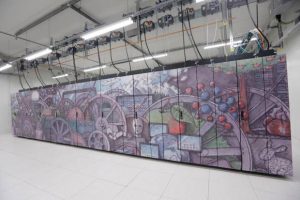
 Yesterday was a good day for computational scientists in Flanders. The new TIER-1 machine, named BrENIAC, located at the university of Leuven, was inaugurated and is now officially open to all users of the Flemish university associations: UAntwerpen, VUB, UGhent, UHasselt, and KULeuven. The name refers to one of the first (super)computers ever built: ENIAC. This new machine will take over the task of the first TIER-1 machine (muk, located at the university of Ghent), which will be decommissioned at the end of this year. BrENIAC is ranked 196th in the current top 500 of supercomputers, and costs 5.5 M€. This is of course without the annual cost of power usage and technical personnel which will maintain the machine and provide support for the scientists running calculations. With its 580 compute nodes, containing 28 cores each (or 2 14-core CPU’s of the type Broadwell E5-2680v4), the number of available cores has roughly doubled. Also memory access should have improved, which gives rise to a theoretical threefold increase of the peak performance.
However, this peak performance is measured with “benchmark” tests, which tend to behave much better than real life programs. This is because the average scientific programmer doesn’t write the best optimized code (ok, “commercial” programs these days may even behave worse :p ) for various reasons, time constraints being one of them. So my first task, before I start running my simulations on the new TIER-1 machine, will be to benchmark VASP and my own HIVE-code.
Two videos of my new sidekick:
You can see me in my front-row position in this picture taken during the non-academic part of the inauguration.
2 comments
2 pings
how fast this tier 1?
Author
At the moment it was started is was 196th in the top 500 of supercomputers worldwide. Speed on the other hand is relative. If your programs are not parallel, such a machine will have little impact. If you have a perfectly parallelized code, then you can gain a lot. But that is not an easy nor trivial task. Within a single node environment OpenMP can help you a lot, but if you want to go beyond that MPI parallelization is needed. VASP (the first-principles code I use for materials science simulations) uses a combination of these techniques, and performs admirably. But sometimes things can go wrong, making life on a supercomputer very interesting.