Tag: defects
| Authors: |
Thijs G.I. van Wijk, E. Aylin Melan, Rani Mary Joy, Emerick Y. Guillaume, Paulius Pobedinskas, Ken Haenen, and Danny E.P. Vanpoucke |
| Journal: |
Carbon 234, 119928 (2025) |
| doi: |
10.1016/j.carbon.2024.119928 |
| IF(2024): |
10.5 |
| export: |
bibtex |
| pdf: |
<Carbon> |
 |
| Graphical Abstract: Schematic representation of the impact of hydrostatic and linear strain on the Zero Phonon Line of the neutral GeV defect in diamond. |
Color centers in diamond, such as the GeV center, are promising candidates for quantum-based applications. Here, we investigate the impact of strain on the zero-phonon line (ZPL) position of GeV0. Both hydrostatic and linear strain are modeled using density functional theory for GeV0concentrations of 1.61 % down to 0.10 %. We present qualitative and quantitative differences between the two strain types: for hydrostatic tensile and compressive strain, red- and blue-shifted ZPL positions are expected, respectively, with a linear relation between the ZPL shift and the experienced stress. By calculating the ZPL shift for varying GeV0 concentrations, a shift of 0.15 nm/GPa (0.38 meV/GPa) is obtained at experimentally relevant concentrations using a hybrid functional. In contrast, only red-shifted ZPL are found for tensile and compressive linear strain along the ⟨100⟩ direction. The calculated ZPL shift exceeds that of hydrostatic strain by at least one order of magnitude, with a significant difference between tensile and compressive strains: 3.2 and 4.8 nm/GPa (8.1 and 11.7 meV/GPa), respectively. In addition, a peak broadening is expected
due to the lifted degeneracy of the GeV0 eg state, calculated to be about 6 meV/GPa. These calculated results are placed in perspective with experimental observations, showing values of ZPL shifts and splittings of comparable magnitude.
Permanent link to this article: https://dannyvanpoucke.be/2025-paper-strainedgev-en/
| Authors: |
Danny E. P. Vanpoucke and Ken Haenen |
| Journal: |
Diam. Relat. Mater 79, 60-69 (2017) |
| doi: |
10.1016/j.diamond.2017.08.009 |
| IF(2017): |
2.232 |
| export: |
bibtex |
| pdf: |
<DiamRelatMater> |
 |
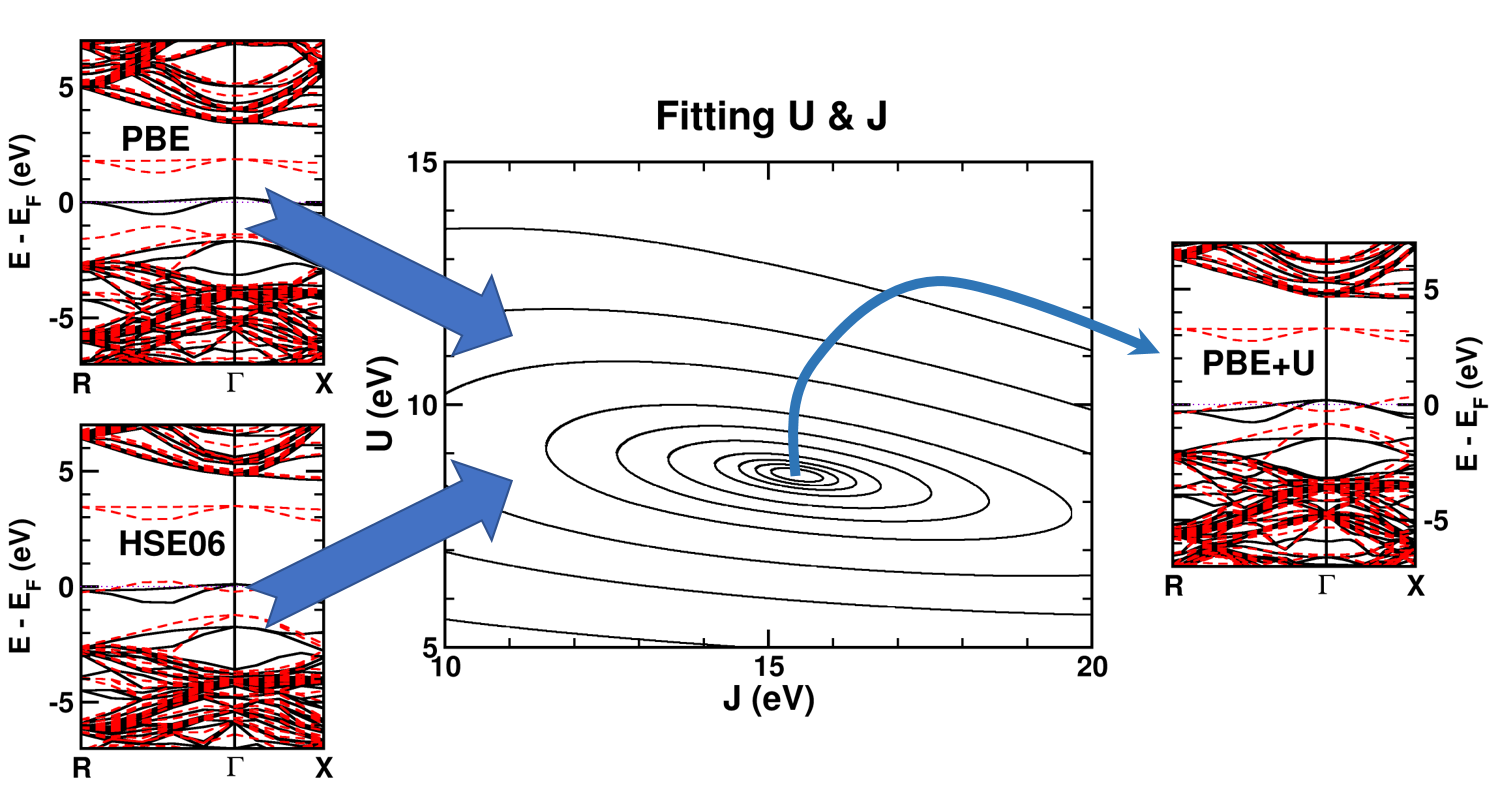
| Graphical Abstract: Combining a scan over possible values for U and J with reference electronic structures obtained using the hybrid functional HSE06, DFT+U can be fit to provide hybrid functional quality electronic structures at the cost of DFT calculations. |
The neutral C-vacancy is investigated using density functional theory calculations. We show that local functionals, such as PBE, can predict the correct stability order of the different spin states, and that the success of this prediction is related to the accurate description of the local magnetic configuration. Despite the correct prediction of the stability order, the PBE functional still fails predicting the defect states correctly. Introduction of a fraction of exact exchange, as is done in hybrid functionals such as HSE06, remedies this failure, but at a steep computational cost. Since the defect states are strongly localized, the introduction of additional on site Coulomb and exchange interactions, through the DFT+U method, is shown to resolve the failure as well, but at a much lower computational cost. In this work, we present optimized U and J parameters for DFT+U calculations, allowing for the accurate prediction of defect states in defective
diamond. Using the PBE optimized atomic structure and the HSE06 optimized electronic structure as reference, a pair of on-site Coulomb and exchange parameters (U,J) are fitted for DFT+U studies of defects in diamond.
Poster-presentation: here

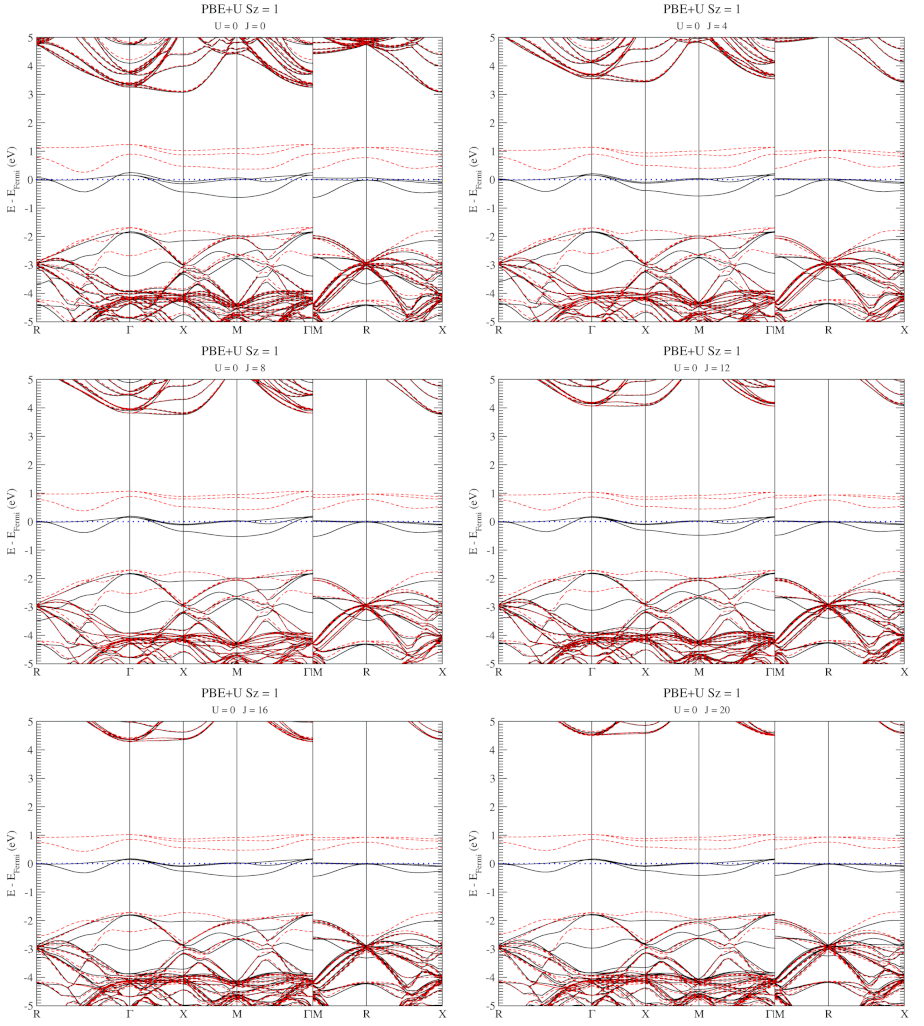
DFT+U series (varying J) for a specific spin state of the C-vacancy defect.
Permanent link to this article: https://dannyvanpoucke.be/paperdrm-diamond-dftu-en/