HIVE-STM: A simple post-processing tool for simulating STM

While I was working on my PhD-thesis on Pt nanowires at the university of Twente, one of the things I needed was a method for simulating scanning-tunneling microscopy (STM) images in a quick and easy way. This was because the main experimental information on on these nanowires was contained in STM-images.

Because I love programming, I ended up writing a Delphi-program for this task. Delphi, being an Object Oriented version of the Pascal-programming language containing a Visual Components Library, was ideally suited for writing an easy to use program with a graphical user interface (GUI). The resulting STM-program was specifically designed for my personal needs and the system I was working on at that time.

In August 2008, I was contacted by two German PhD students, with the request if it would be possible for them to use my STM program. In October, an American post-doc and a South-Korean graduate student followed with similar requests, from which point onward I started getting more and more requests from researchers from all over the world. Now, seven years later, I decided to put all “HIVE-users” in a small data-base just to keep track of their number and their affiliation. I already knew I send the program to quite a lot of people, but I was still amazed to discover that it were 225 people from 34 countries.
Hive Requests December 2015

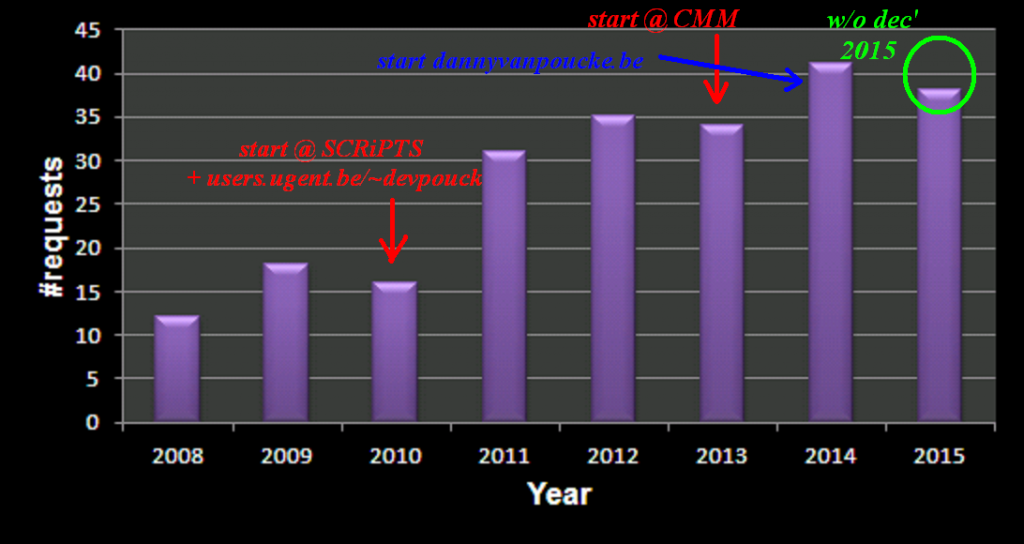
Bar-graph showing the evolution in requests for the HIVE-STM program.

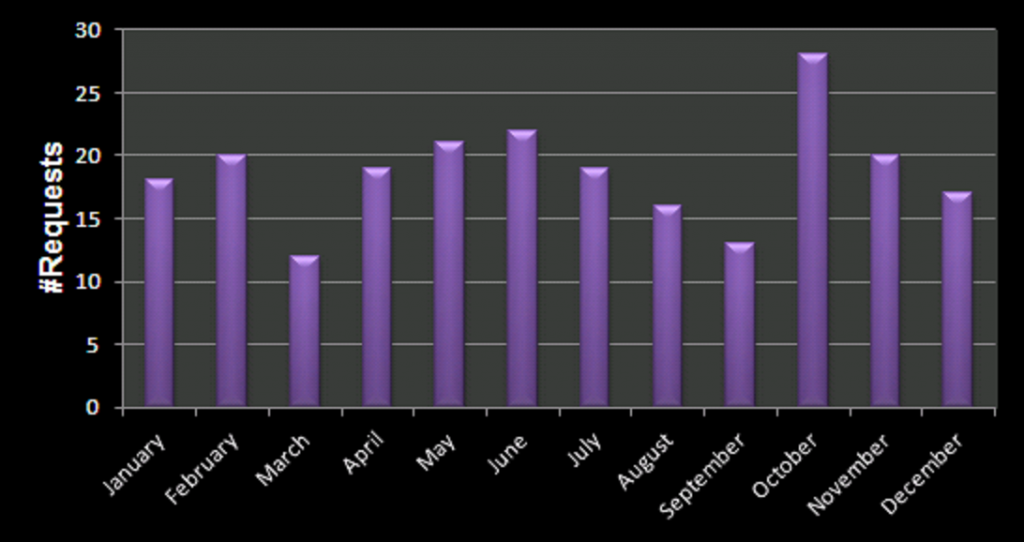
There is a slow but steady increase in requests over the years, with currently on average about one request every week. It is also funny to see there was a slight setback in requests both times I started in a new research-group. For 2015, the data is incomplete, as it does not include all requests of the month December. Another way to distribute the requests is by the month of the year. This is a very interesting graph, since it clearly shows the start of the academic year (October). There are two clear minima (March and September), for which the later is probably related due to the fact that it is the last month of before the start of the academic year (much preparation for new courses) and, in case of the solid state community, this month is also filled with conferences. The reason why there is a minimum in March, however, escapes me ( 💡 all suggestions are welcome 💡 ).
Hive requests per month.

Distribution of requests for the HIVE-STM program on a monthly basis.

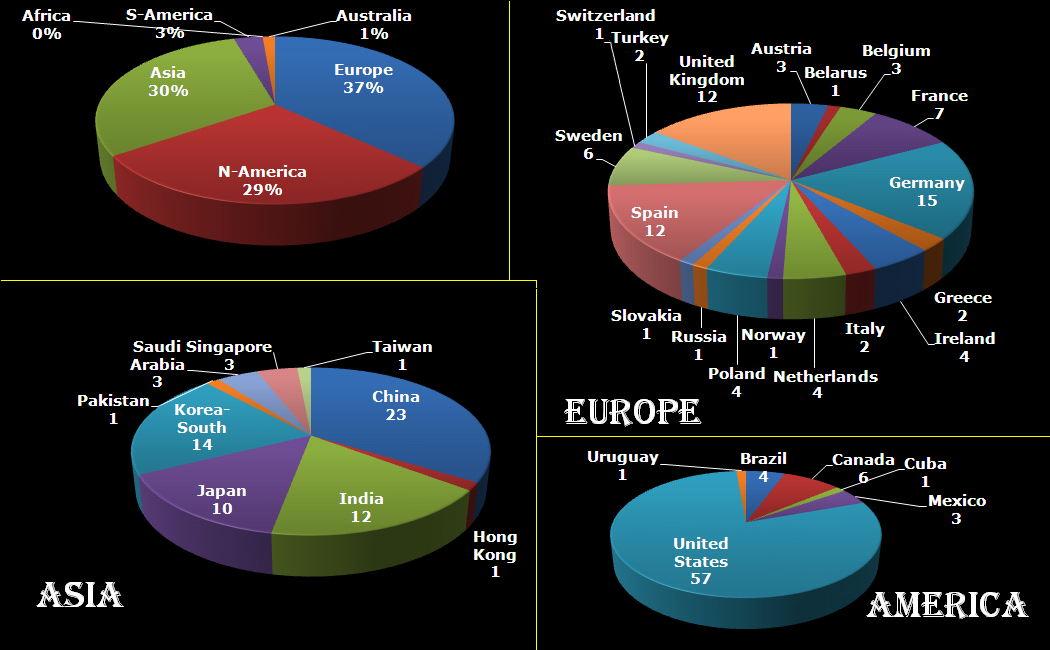
The geographic distribution of affiliations of those requesting the STM-program shows Europe, Azia and America to take roughly equal shares, while African affiliations are missing entirety. Hopefully this will change after the workshop on visualization and analysis of VASP outputs delivered at the Center for High Performance Computing‘s 9th National Meeting in South Africa by Dr. David Carballal. By far the most requests come from the USA (57), followed by China(23) and then Germany(15). South-Korea(14) unexpectedly takes the fourth place, while the fifth place is a tie between the UK, Spain and India(12 each).
Hive requests demographics 2015

Distribution of Hive requests per country and continent.

All in all, the STM program seems to be of interest to many more researchers than I would have ever expected, and has currently been cited about 25 times, so it is time to add a page listing these papers as examples of what can be done with HIVE(which has in the mean time been done, check out useful link n°2).

Happy Hiving to all of you, and thank you for your trust.


Useful link:
[1] More information on the HIVE-STM program and how to acquire it.

[2] List of publications using and citing the HIVE-STM program.

Permanent link to this article: https://dannyvanpoucke.be/hive-stm-db-2015-en/

Robbert Dijkgraaf Essay Contest

In the previous posts, I presented my contribution (original Dutch version / English translation) to the Robbert Dijkgraaf essay contest. This year’s theme was on the importance of imagination in science. My girlfriend, Sylvia, also participated in this essay contest. We read each-others contributions as a final check before submission, and at that point it became clear to me I was out of my league 😳 .

During the gala of science in Amsterdam, the winner of the Robbert Dijkgraaf essay contest was made public. And the winner is: Sylvia Wenmackers.

On her blog you can read the winning essay (in Dutch), and you will understand why I immediately knew my essay was outclassed. Congratulations again my dear 😀 .


Permanent link to this article: https://dannyvanpoucke.be/rd-essay-contest-2015-en/

Sidekick

This year I participated in the Robbert Dijkgraaf essay-contest 2015.
The central theme of the contest was imagination, and in my contribution
I presented the role of imagination in computational materials science,
and why it is so important for this field

The original Dutch version of the essay can be found here.


Imagine a world where you can actually see atoms. Even more, you can use them as LEGOs and manipulate them to do your bidding. Imagine a world in which you can switch off the laws of nature, or create new ones which are more to your liking. In such a world, you are in charge. Welcome to my world: the world of “computational materials science“.

It would be a nice start for a commercial for this research field. The accompanying clip would then show images fading into one another of supercomputers and animations of chemical and biochemical processes at the atomic scale. Moving in a fast-forward pace into our future with science-fiction-like orbital labs where calculated materials are immediately transformed into new medicine, ultra-thin screens and applications for the aerospace industry. scifilabThe ever faster flood of images culminates in the final slogan:”Simulate the future” with a subtext urging you to go study computational materials science. I assume that such a clip would tempt peoples imagination. It addresses our human urge to create, and holds the promise that you can do anything you want, as long as you can imagine it. In fact, your imagination becomes the only limiting factor.

As with most commercial, this one also presents reality slightly more beautiful than it actually is. As for any other scientist in any other field, your contribution to progress as a computational materials scientist is rather more limited than you would like it to be. This is a normal aspect of science. The presented divine omnipotence and omniscience, on the other had, are attainable. As a computational scientist you do have absolute control over the atomic positions and the forces at play. In contrast, an experimental scientist is forced to deal with the quirks of nature and his or her machinery. This omnipotence allows you to create any world you can imagine…inside a computer.

As a scientist, you wish to understand the world around you. This limits the freedom you gained through your omnipotence, unless you would choose to join a team of game-designers. It, however, does not mean that your creativity is curtailed in any way. On the contrary. Where the team of game-designers knows the entire story to be told, including rules and laws of nature relevant for the game world, this is not the case for computational materials science. For the latter it is often their quest to discover the story-line as they go, including relevant laws of nature. As a computational materials scientist, you become the narrator, whose task consist of thinking up new stories time and time again. The narrator, who needs to tweak existing plots, extending or confining story-lines, until the final story fits the shape of reality.

Luckily, you are not alone to bring this daunting task to a successful end. You always have the support of your loyal sidekick: your supercomputer. Using its brute force, your sidekick calculates the effects of any intrigue or plot twist you can imagine. Based on your introductory chapter, in which you describe the world and its natural laws, it will allow the story to unfold. By asking him the right questions, and comparing his answers to reality, you learn which parts of your story don’t really fit reality yet.

Ouroboros benzene. source: wikipediaHow you should rewrite your introductory chapter differs every time. Sometimes it is clear what is going on: an essential character is missing (e.g. an impurity atom which is distorting the crystal lattice), or the character lives at the wrong location (not site A, then let us see about site B?). It becomes more difficult when a character refuses to play the role it was dealt (e.g. Pt atoms that remain invisible for STM, so who is going to play the role of the nanowire we observe?). The most difficult situation occurs with the need for a full rewrite of the introductory chapter. This provides too much freedom, since it is our knowledge of the limitations of reality which provides the necessary support and guidance for drafting the story-line. In such a case, you need an inspiring idea which provides you with a new point of view. Inspiration can come in many forms and at any time, often when least expected. A well-known example is this of the theoretical chemist Kekulé who, in a daydream, saw a snake bite its own tail. As a result Kekulé was able to envision the ring-shape of the benzene molecule. Such wonderful problem solving twists-of-mind are rare. They are often the consequence of long and intense study of a single problem, which drive you to the limit, since they require you to imagine something you have never thought of before. In management-circles this is called “thinking-outside-the-box”, which sound a lot easier than it actually is. It does not mean that all of the sudden everything goes, you always have to bear in mind the actual box you started from.

As a computational materials scientist you have to combine your omnipotence over your virtual world with your power to imagine new worlds, hoping to see a glimmer of reality in the reflections of your silicon chips.

Permanent link to this article: https://dannyvanpoucke.be/sidekick-en/

Sidekick

Met dit essay nam ik deel aan de Robbert Dijkgraaf essay-prijs 2015.
Dit jaar was het thema verbeelding, en in mijn bijdrage doe ik een
poging de rol van verbeelding naar voren te brengen binnen
computationeel materiaalonderzoek. Ik probeer eveneens uit te
leggen hoe ik computationeel onderzoek zie als onderzoeksdomein. 

Een vertaling naar het Engels kan hier gevonden worden.


Stel je een wereld voor waarin je atomen kunt zien. Meer nog, je kunt ze stapelen als legoblokken en manipuleren naar eigen goeddunken. Stel je een wereld voor waarin je de natuurwetten kunt aan- of afzetten, een wereld waar je zelf nieuwe natuurwetten kunt schrijven. In zo een wereld heb jij het voor het zeggen. Welkom in mijn wereld, de wereld van het “computationele materiaalonderzoek“.

Het zou een mooi begin zijn van een reclamespot voor dit onderzoeksgebied. In de bijhorende clip krijg je in elkaar overgaande beelden te zien van supercomputers enerzijds en animaties van chemische en biochemische processen op de atomaire schaal anderzijds. Het geheel wordt dan doorgelinkt aan onze eigen toekomst met sciencefictionachtige laboratoria waar de berekende materialen direct worden omgezet tot nieuwe medicijnen, flinterdunne beeldschermen en toepassing voor de ruimtevaart. De steeds sneller elkaar opvolgende beelden scifilabculmineren dan in de slotslogan: “Simuleer de toekomst!” met als onderschrift de aansporing om computationeel materiaalonderzoek te gaan studeren. Ik stel me voor dat zo’n reclameclip wel tot de verbeelding zou spreken. Het spreekt onze menselijke drang om te creëren aan met de belofte dat je alles kunt, als je het je maar kunt voorstellen. Je verbeelding is de enige beperkende factor.

Zoals bij de meeste reclamespots wordt ook in deze de werkelijkheid iets mooier voorgesteld dan ze is. Zoals voor elke andere wetenschapper geldt immers dat je bijdrage aan de vooruitgang beperkter is dan je zou willen. De gepresenteerde goddelijke almacht en alwetendheid liggen wel binnen handbereik. Als computationeel onderzoeker heb je immers absolute controle over de plaatsing van atomen en de inwerkende krachten, iets waar een experimenteel onderzoeker deels is overgelaten aan de grillen van de natuur en zijn of haar apparatuur. Deze controlevrijheid laat je toe, binnen een computer, elke wereld te creëren die je maar kunt bedenken.

Als wetenschapper wil je de wereld om je heen begrijpen, wat bovenstaande vrijheden inperkt, tenzij je ervoor kiest om in een team van computergame-designers aan de slag gaan. Dit betekent niet dat je creativiteit wordt beknot, integendeel. Waar bij het ontwerpteam het volledige verhaal bekend is, inclusief de regels en natuurwetten van de wereld waarin je speelt, is dat niet het geval bij computationeel materiaalonderzoek. Meer nog, vaak is het net je opdracht het verhaal gaandeweg te ontdekken, inclusief de natuurwetten die relevant zijn. Je wordt als het ware een verteller die telkens nieuwe verhalen moet bedenken, of bestaande plots moet aanpassen, uitbreiden of beperken, tot de verhaallijn past in de vorm van de werkelijkheid.

Je staat er gelukkig niet alleen voor om een goede afloop te regelen. Je wordt bijgestaan door je trouwe sidekick: je supercomputer. Deze is in staat met brute kracht de gekste plotwendingen door te rekenen. Op basis van jouw inleidende hoofdstuk, waarin je de wereld en haar natuurwetten schetst, zal hij het verhaal verder laten ontplooien. Door dan de juiste vragen te stellen en de antwoorden met de werkelijkheid te vergelijken kom je erachter waar je verhaal nog niet helemaal in de werkelijkheid past.

Hoe je je inleidende hoofdstuk daarop moet aanpassen verschilt per geval. Soms is het duidelijk wat er aan de hand is: er ontbreekt een cruciaal personage (bijvoorbeeld een onzuiverheidsatoom dat het kristaalrooster verstoord) of het personage woont op de foute plaats (toch niet op de plaats van atoom A, atoom B dan maar?). Moeilijker wordt het als sommige personages weigeren de hun toebedeelde rol te spelen (Die platina-atomen zijn onzichtbaar voor de rastertunnelmicroscoop, wie speelt nu de rol van de zichtbare nanodraad?).Ouroboros benzene. source: wikipedia De lastigste situatie is wanneer een volledige herschrijving van het inleidende hoofdstuk nodig is. Hierdoor krijg je te veel vrijheid in handen, terwijl het net de gekende beperkingen zijn die je houvast geven bij het opstellen van het verhaal. Je hebt dan een idee nodig dat je een link geeft met de werkelijkheid. Inspiratie kan hier velerlei vormen aannemen en op willekeurig moment komen. Een bekende anekdote is deze van de theoretische chemicus Kekulé, die in een dagdroom een slang zichzelf in de staart zag bijten en daardoor de ringvormige structuur van de benzeenmolecule uitdokterde. Zulke wonderlijk probleemoplossende gedachtenkronkels komen zelden spontaan, maar zijn veeleer het gevolg van lang en intens werk op eenzelfde vraagstuk. Dergelijke situaties drijven je tot het uiterste, je moet je immers iets voorstellen waar je nooit eerder aan gedacht hebt. In managementkringen wordt zoiets “buiten het kader denken” genoemd, wat bedrieglijk eenvoudig klinkt. Je mag immers niet vergeten dat voor onderzoek dit niet betekent dat alles plots toegelaten is (met andere woorden, je mag het kader zeker niet uit het oog verliezen bij het dagdromen).

Als computationeel materiaalonderzoeker moet je dus je almacht over je virtuele wereld combineren met je eigen vermogen nieuwe werelden in gedachten te scheppen, in de hoop zo onderweg een glimp van de buitenwereld in je siliciumchip op te vangen.

Permanent link to this article: https://dannyvanpoucke.be/sidekick-nl/

Publish or perish: of predatory journals and open-access scams

Mantra

In the current academic world, there are two often heard mantra’s: publish more and publish open access. In a world where there are ever more researchers competing for limited financial resources, distribution of these resources needs persistent justification. While funding agencies seem to be in a relentless quest for ‘excellence‘ in research (or just more publications, because that is easily quantifiable), a new side-quest has emerged: ‘open access publication’. This side-quest can either be considered as a move against scientific publishers requesting huge subscription fees from universities or as a further way of justifying what is being done with tax-payer money (with open access the tax-payer can go find out him-/herself ).

Predators

predator by sweens07, http://cyrax-494.deviantart.com/art/Predator-410150978The publish or perish culture has lead to the birth of predatory journals and publishers. These journals more and more act as regular journals (e.g. promising/claiming peer review). However, in the end, as long as a publishing fee is paid your paper will get published. Researchers of ill intend can easily get their work published in such journals and as such inflate their CV. Unfortunately, also poorly informed researchers, with no ill intend, can be trapped by such journals. These journals use rather aggressive mailing campaigns (I generally get a few of these e-mails every week on my academic mail account) and present journals with names rather similar to well established journals. Luckily, after a while you start to recognize the usual predatory publishers such as scirp, bentham science publishers or hindawi publishing. The setup of their mailings are rather similar. There are two main types: the professional journal type and the personal interest type. The first setup starts by presenting their journal as brand new and of high interest to field, indicating that the journal is indexed in several listings (giving it the impression of validity) and finally that there is a publishing charge (which generally isn’t that steep, 100-200$). The second type approaches you noting they have read one of your recent publications, and consider it to be of great quality and interest to the world. After sufficient flattery you are then invited to publish new work with them (which can be done at a special discount).

Predators v2.0

Lately, with the recent quest for open-access publishing (funding agencies/universities requiring of their researchers to publish open access*) these predatory journals moved on. Nowadays, you do not need to pay for publication any longer, you now pay for the “open access” of your work. In my case, the most recent invitation was by intechopen. I was invited to write a chapter in a book on Metal-Organic Frameworks, and since it is open access, it would only cost 670€ in processing charges. No thank you. After a reminder by the publishing process manager I put in the effort to check if they are already blacklisted as a predatory journal/publisher, and yes they are: Jeffrey Beal’s list of predatory publishers. (For the record, if you are invited to write a paper/book-chapter there should be no page/processing charges at all, on the contrary you should actually get a (small) fee.)

How to discern a legitimate journal from a predatory journal?

This question is becoming harder to answer every year. With open access, also regular publishers have discovered a new gold-mine which they are rather eager to excavate. Also with the huge flood of publications that all need to be reviewed by multiple referees, quality in that area starts to degrade slightly but steadily. So what to do?

  1. First, check if it is a journal you have been reading papers from, and remind yourself what ybealls-listou thought of the quality of those papers. You can also ask your colleagues what they think of the quality.
  2. Second, check if the journal actually has an impact factor on for example web of science (if that is the usual practice in your field). This is similar as checking with a credit rating agencies about the status of a country…which may in the long run not be as flawless as expected.
  3. Third, check if the journal/publisher has been blacklisted in the ever expanding list of predatory publishers by Jeffrey Beall. (Although there is some discussion on the validity of the list itself, I believe it to be a good starting point if you are in doubt.)

*They, however, tend to have conflicting standards in this regard. You are on the one hand encouraged to publish in high impact journals and you are required to publish open access. On the other hand however, no additional funding is provided to pay for the open access costs in high impact journals. These costs are often several thousand euros for one publication, or more than half an FWO bench-fee which is to be used for visiting conferences, buying lab equipment or computational resources.

Permanent link to this article: https://dannyvanpoucke.be/oa-scams-en/

A Flexible Photoactive Titanium Metal-Organic Framework Based on a [TiIV33-O)(O)2(COO)6] Cluster

Authors: Bart Bueken, Frederik Vermoortele, Danny E. P. Vanpoucke, Helge Reinsch, Chih-Chin Tsou, Pieterjan Valvekens, Trees De Baerdemaeker, Rob Ameloot, Christine E. A. Kirschhock, Veronique Van Speybroeck, James M. Mayer and Dirk De Vos
Journal: Angew. Chem. Int. Ed. 54(47), 13912-13917 (2015)
doi: 10.1002/anie.201505512
IF(2015): 11.705
export: bibtex
pdf: <Angew.Chem.Int.Ed.> 

Abstract

The synthesis of titanium-carboxylate metal-organic frameworks (MOFs) is hampered by the high reactivity of the commonly employed alkoxide precursors. Here, we present an innovative approach to Ti-based MOFs using titanocene dichloride to synthesize COK-69, the first breathing Ti-MOF built up of trans-1,4- cyclohexanedicarboxylate linkers and an unprecedented [TiIV33-O)(O)2(COO)6] cluster. The photoactive properties of COK-69 were investigated in-depth by proton-coupled electron transfer experiments, which revealed that up to one TiIV per cluster can be photoreduced to TiIII, while preserving the structural integrity of the framework. From molecular modeling, the electronic structure of COK-69 was determined and a band gap of 3.77 eV was found.

Permanent link to this article: https://dannyvanpoucke.be/paper2015_aniecok69-en/

Cover Image of Crystal Engineering Communications: Fine-tuning the theoretically predicted structure of MIL-47(V) with the aid of powder X-ray diffraction

Authors: Thomas Bogaerts, Louis Vanduyfhuys, Danny E.P. Vanpoucke, Jelle Wieme, Michel Waroquier, Pascal Van Der Voort, and Veronique Van Speybroeck,
Journal: CrystEngComm. 17(45), 8565 (2015)
doi: 10.1039/C5CE90198G
IF(2015): 3.849
export: bibtex
pdf: <CrystEngComm>

Abstract

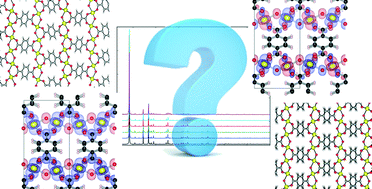
The cover image depicts an X-ray beam hitting a sample of MIL-47(V) Metal-Organic Framework (reddish powder), resulting in an X-ray diffraction pattern. This leads to the atomic structure on the left, Where the spin-densities are indicated for the anti-ferromagnetic ground state.  (The related paper can be found here.)


Cover of CrystEngComm: Volume 17, Issue 45, dec. 7, 2015

Permanent link to this article: https://dannyvanpoucke.be/paper2015_xrdthomasdannycover-en/

Understanding intrinsic light absorption properties of UiO-66 frameworks: A combined theoretical and experimental study

Authors: Kevin Hendrickx, Danny E.P. Vanpoucke, Karen Leus, Kurt Lejaeghere,
Andy Van Yperen-De Deyne, Veronique Van Speybroeck, Pascal Van Der
Voort, and Karen Hemelsoet
Journal: Inorg. Chem. 54(22), 10701-10710 (2015)
doi: 10.1021/acs.inorgchem.5b01593
IF(2015): 4.820
export: bibtex
pdf:  <Inorg.Chem.>

Abstract

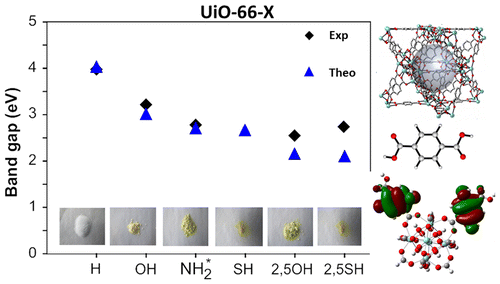
Linker-functionalization of UiO-66 modifies the optical band gap and thus the color of the MOF.

Linker-functionalization of UiO-66 modifies the optical band gap and thus the color of the MOF.

A combined theoretical and experimental study is performed in order to elucidate the eff ects of linker functional groups on the photoabsorption properties of UiO-66-type materials. This study, in which both mono- and di-functionalized linkers (with X= -OH, -NH2, -SH) are studied, aims to obtain a more complete picture on the choice of functionalization. Static Time-Dependent Density Functional Theory (TD-DFT) calculations combined with Molecular Dynamics simulations are performed on the linkers and compared to experimental UV/VIS spectra, in order to understand the electronic eff ects governing the absorption spectra. Di-substituted linkers show larger shifts compared to mono-substituted variants, making them promising candidates for further study as photocatalysts. Next, the interaction between the linker and the inorganic part of the framework is theoretically investigated using a cluster model. The proposed Ligand-to-Metal-Charge Transfer (LMCT) is theoretically observed and is influenced by the differences in functionalization. Finally, computed electronic properties of the periodic UiO-66 materials reveal that the band gap can be altered by linker functionalization and ranges from 4.0 down to 2.2 eV. Study of the periodic Density of States (DOS) allows to explain the band gap modulations of the framework in terms of a functionalization-induced band in the band gap of the original UiO-66 host.

Permanent link to this article: https://dannyvanpoucke.be/paper2015_inorgchemuio66-en/

Mechanical Properties from Periodic PlaneWave Quantum Mechanical Codes: The Challenge of the Flexible Nanoporous MIL-47(V) Framework

Authors: Danny E. P. Vanpoucke, Kurt Lejaeghere, Veronique Van Speybroeck, Michel Waroquier, and An
Ghysels
Journal: J. Phys. Chem. C 119(41), 23752-23766 (2015)
doi: 10.1021/acs.jpcc.5b06809
IF(2015): 4.509
export: bibtex
pdf: <J.Phys.Chem.C> 
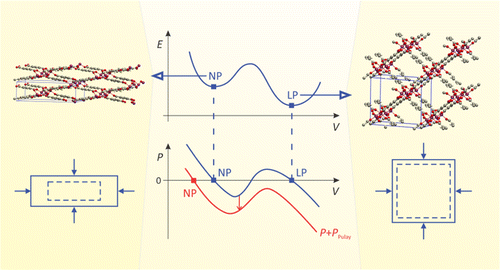
Graphical Abstract: Pulay stresses complicate the structure optimization of the breathing MIL-47(V) Metal-Organic Framework.

Abstract

Modeling the flexibility of metal–organic frameworks (MOFs) requires the computation of mechanical properties from first principles, e.g., for screening of materials in a database, for gaining insight into structural transformations, and for force field development. However, this paper shows that computations with periodic density functional theory are challenged by the flexibility of these materials: guidelines from experience with standard solid-state calculations cannot be simply transferred to flexible porous frameworks. Our test case, the MIL-47(V) material, has a large-pore and a narrow-pore shape. The effect of Pulay stress (cf. Pulay forces) leads to drastic errors for a simple structure optimization of the flexible MIL-47(V) material. Pulay stress is an artificial stress that tends to lower the volume and is caused by the finite size of the plane wave basis set. We have investigated the importance of this Pulay stress, of symmetry breaking, and of k-point sampling on (a) the structure optimization and (b) mechanical properties such as elastic constants and bulk modulus, of both the large-pore and narrow-pore structure of MIL-47(V). We found that, in the structure optimization, Pulay effects should be avoided by using a fitting procedure, in which an equation of state E(V) (EOS) is fit to a series of energy versus volume points. Manual symmetry breaking could successfully lower the energy of MIL-47(V) by distorting the vanadium–oxide distances in the vanadyl chains and by rotating the benzene linkers. For the mechanical properties, the curvature of the EOS curve was compared with the Reuss bulk modulus, derived from the elastic tensor in the harmonic approximation. Errors induced by anharmonicity, the eggbox effect, and Pulay effects propagate into the Reuss modulus. The strong coupling of the unit cell axes when the unit cell deforms expresses itself in numerical instability of the Reuss modulus. For a flexible material, it is therefore advisible to resort to the EOS fit procedure.

Permanent link to this article: https://dannyvanpoucke.be/paper2015_accuratemofs-en/

Experimental truths

In statistics there exist a well known aphorism:

All models are wrong but some are useful.

— George Edward Pelham Box, 1919-2013


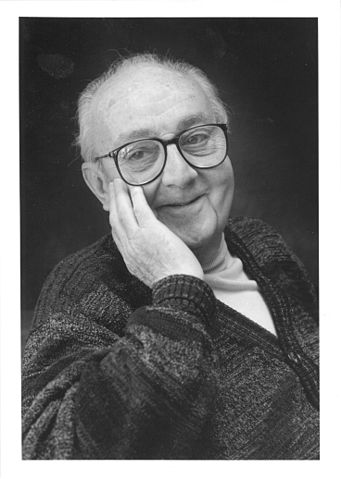
"George E. P. Box" by DavidMCEddy

“George E. P. Box” by DavidMCEddy

From the point of view of the definition of the word “model” this is true in an absolute sense, since a model implicitly means approximations are made, and as such discrepancies with “the real system” exist. As a result, this real system is considered as the only “not wrong” description of itself. In the exact sciences, the real system is often nature. This may lead some scientists to believe that experimental results, and by extension conclusions based on them, are true by default. When confronted with theoretical results in disagreement with experimental conclusions, the quick response entails a failure of the theoretical model used since it is not real nature that was worked with, but only a model.

Quite often this is true, and leads to the formulation of new and better models of reality: This allowed, for example, Newton’s laws of motion to evolve to special relativity and further to general relativity. However, equally often (in materials science at least) something else may be going on: The scientist may have forgotten that the experimentalist is also using a model to create his/her experimental results. Broadly speaking, experimental results can be categorized as either being direct or indirect results. Direct results are what you could call “WYSIWYG”-results. What you measure is the quantity you are interested in: e.g. contact angles of liquids by measuring the angle between a drop of the liquid and the substrate surface, the scanning tunneling and atomic force microscopy pictures of a surface,… Indirect results on the other hand, require some post-processing of a direct result to obtain the quantity of interest. This post-processing step includes the use of a model which links the direct result to the property of interest. e.g. The atomic structure of a material. Here the direct result would be the measured X-ray diffraction (XRD) spectrum, while the model and its assumptions are nowadays neatly hidden in well-performing software. This software will try to fit known crystal models to obtain lattice parameters and atomic positions for the XRD spectrum provided. This means however that the obtained result is the best fit that can be obtained, which is not necessarily the actual atomic structure.

Graphical Abstract for paper: Fine-tuning the theoretically predicted structure of MIL-47(V) with the aid of powder X-ray diffraction.

Graphical Abstract for paper: Fine-tuning the theoretically predicted structure of MIL-47(V) with the aid of powder X-ray diffraction.

Another important aspect to remember in regard to experimental results is the fact that different samples are truly different systems. For example, a material grown as a single crystal or synthesized as a powder may give subtly different XRD-spectra. In a recent paper with Thomas Bogaerts, we investigated how well different models for the MIL-47(V) Metal Organic Framework (MOF) fitted to experimental XRD spectra of this material. We found that depending on which experimental spectrum (single crystal or powder XRD) we fitted to, a different model was preferred, showing nature to have multiple truths for the same system. The structural difference between these models is minute, since the models entail different spin configurations on the same topology. However, the effort required for the more extended fitting procedure performed by Thomas is well worth it, since it provided a new (indirect) method for determining the spin-configuration in these rather complex structure, giving access to slightly less-wrong models for the future.


Permanent link to this article: https://dannyvanpoucke.be/experimental-truths-en/