Most commented posts
- Phonons: shake those atoms — 3 comments
- Start to Fortran — 1 comment

Feb 01 2015
The last three days of the conference, the virtual materials design session took place. This session was specifically focused on computational materials design. Because of this focus, the attendance was rather low, mainly computational materials scientists. Apparently, this type of specialized focus on computational work is the best way not to reach the general experimental public in the same field. As a computational scientist the only way to circumvent this, is by applying for a presentation in a relevant experimental session. This requires you to make a less technical presentation, but this is not a bad thing, since it forces you to think about your results and understand them in more simple terms.
An example of such a presentation was given Dr. Ong who discussed his high-throughput ab initio setup for designing solid state electrolytes. He showed that a material (Li10GeP2S12) which was thought to be a 1D conductor, actually is a 3D conductor, however, the Li-conductivity in the directions perpendicular to the 1D direction is ~100 times smaller, explaining why they were not noticed before. He also presented newly predicted materials for Li-transport, which lead to a standard experimental remark that such computational predictions mean very little, since they do not take into account temperature, and as such these structures may not be stable. Although such remarks are “in theory” true, and are a nice example of a lack of understanding outside the computational community, in this case, the material the experimental researcher was referring to was recently synthesized and found to be stable.
On Thursday morning, I had the opportunity to present my contributed presentation. In contrast to my invited presentation, this presentation was solely focused on doped cerium dioxide. Using a three-step approach, we investigated all different contributions of the dopants to their modification of the mechanical properties of CeO2. In the first step, we look at group IV dopants, since Ce has an oxidation state of +IV in CeO2. Here we show that the character of the valence electrons (p or d) plays an important role with regard to stability and mechanical properties. In our second step dopants with an oxidation state different from +IV are considered, without the presence of oxygen vacancies. In this case, the same trends and behavior is observed as in the first step. In the third and last step also oxygen vacancies are included. We show that oxygen vacancies have a stabilizing influence of the doped system. Furthermore, the oxygen vacancies make CeO2 mechanically softer, i.e. reducing the bulk modulus.
In the afternoon, Prof. Frederico Rosei, of NanoFemto lab in Canada, gave an entertaining lecture on “Mentorship for young scientists: Developing scientific survival skills”. It presented an interesting forum to find out that, as scientists, we all seem to struggle with the same things. We want to do what we like (research), and invest a lot in this, unfortunately external forces (the struggle for funding/job security) complicate life. Frederico centered his lecture around three points of importance/goals a young scientist should always try to be aware of:
Although these are lofty goals, they tend to be quite none-trivial in the current-day scientific environment. Finding a mentor, i.e. a senior scientist with time on his/her hands not involved in your projects, is a bit like looking for a unicorn. Unlike the unicorn, they do exist, but there are very very few of them (How many professors do you know with spare time?). Planning ahead, and following your own plans are nice in theory, unfortunately a young scientists’ life (i.e. everyone below tenured professorship) tends to be ruled by funding in a kind of life or dead setup. I am not saying this is not the case for tenured professors, however, it is not their own life and death. For all other scientist : No funding=no job=end scientific career. As such, the pressure to publish (yes, funding agencies only count your papers, not how good/bad they are even though that is the official statement) is high, and will have a detrimental influence on the quality of science and of what is being published (if it isn’t already the case). I truly wished, the world could be as Prof. Rosei envisions it. Back to more happy subjects.
Friday was the last day of the conference. In the morning I again attended the virtual materials design session, but as with all other sessions several presentations were canceled, apparently snow is wreaking some havoc in New York airport, preventing several presenters not to be able to make it. Luckily Eva Zarkadoula made it to the conference to present her very nice modeling work: “Molecular Dynamic Simulations of Synergistic Effects in Ion Track Formation”. Using classical molecular dynamics simulations, she simulated how incoming high energy radiation traces a path trough a material allowing one to use this material as a detector. In contrast to what I would have imagined, perfectly crystalline material shows very little damage after the radiation has passed through. Even though initially a clear trace is visible, the system appear to relax back to a more or less perfect crystalline solid upon relaxation, making it a rather poor sensor material. However, if defects are present in the material, the track made by the radiation remains clearly visible. An extremely nice bonus to this work is the fact that direct comparison to experiments is possible.
The conference ended at noon, leaving some time to have a walk on the beach, find some souvenirs, and have a last dinner with colleagues from the conference.
Jan 28 2015
Today I had to get to work myself, unlike the first day of the ICACC where I was only a spectator. At 8h30 I kicked of the GYIF as the first speaker in a session called “Theoretical Modeling and Applications” with my presentation: Computational Materials Science: Where Theory meets Experiment. Intended for a general audience of (expectedly mainly) experimental materials scientist this presentation was aimed to show the audience that computational materials science has in the last decades developed to the level where results relevant for real-life applications in materials science can be obtained. For this I used three examples of my own work: (1) Pt nanowires on Ge(001), where I used simulated STM to build an accurate atomistic model of these wires, (2) doped cerium oxides, where the influence of doping on lattice parameter and thermal expansion coefficients was studied for the purpose of matching them to those of other materials, and (3) Metal-Organic Frameworks, where I showed that the spin-configuration of the MIL-47(V) MOF is linked to the transition pressure inducing breathing.
Later on during the morning, I had the pleasure of chairing the session “Additive Manufacturing” together with Valerie Wiesner from NASA. During this session Mahref Vali and Lisa Rueschoff presented their most recent work on 3D printing of ceramic materials, a technique which will allow the printing of ceramic components in the future. The third speaker of this session, Rumi Kitazawa, delighted us with an inspiring talk on the “Engineering applications of Menger sponges”. A Menger sponge is a fractal related to the Cantor set, as such a fully developed Menger sponge can not be build with any real material, however, using 3D printing it is possible to build a structure with Menger sponge like features (i.e. with holes down to a certain size). By comparing experimental stress tests on such 3D-printed systems with calculations of the strain energy in such a structure, Rumi was able to show these Menger materials have a peculiar, albeit very organised, strain pattern along the main diagonal of the material. The combination of large and small pores present in these Menger sponge materials may make this behavior relevant for MOF (and other porous) materials, where the large pores reflect inter-grain pores, while the small pores are the pores of the MOF. So this is definitely a topic to remember.
Next to presentations, conferences also contain social events. Today, there were two social events; at noon there was a luncheon by the GYIF where the young investigators could mix with people from industry and senior group leaders. In the evening there was the first poster session and booth-stand where companies try to sell their services and lab equipment. Somehow, as a theoretician, I am always a bit at a loss at such events. To draw in more people, there was also a shot-glass contest. No, it was not the goal to drink as much as possible, but to build a protective structure around a shot-glass using only 15 drinking straws (no tape, wire, paper, staples,… allowed). To find the most protective structure, the shot-glass and straw constructions were dropped from various heights. Twenty four teams started at a drop height of 3 feet (~1 m), where already the first shot-glass didn’t survive the drop. Every round, the drop height was increased by 3 feet. For a drop of 20 feet (~6 m) there were only two teams remaining, including our team. Altough our glass survived its first bounce, the second bounce unfortunately broke our glass (darn). Then it was the turn of our remaining competitor, who’s shot-glass exploded into shards on first impact. Officially the result was a draw, although it is clear our construct had clearly the upper hand 😎 .
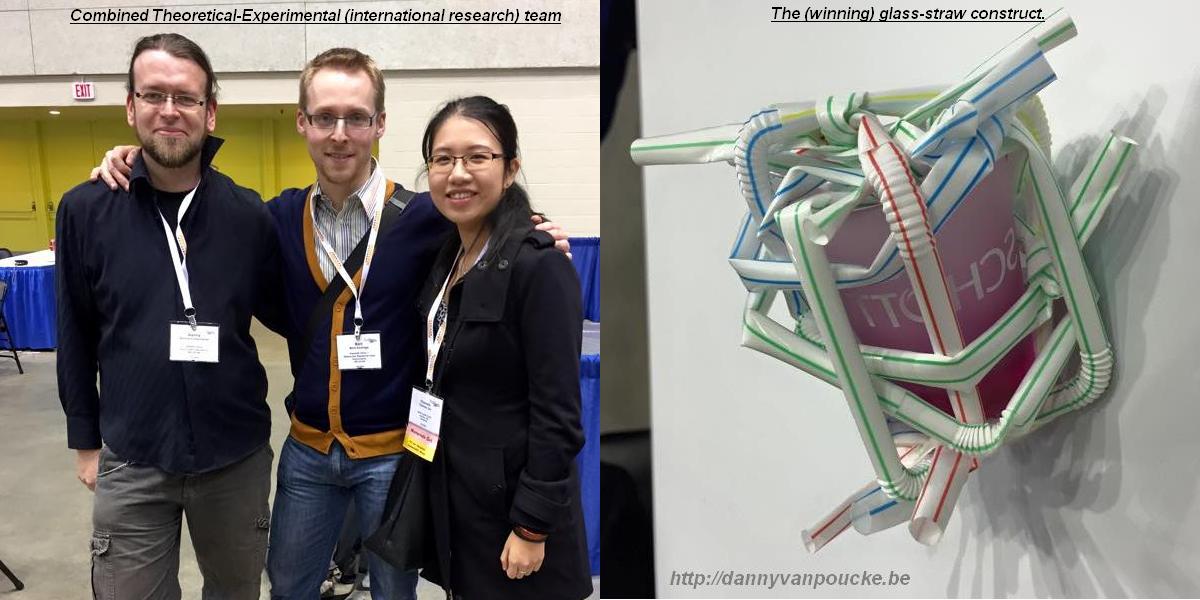
Our mixed Theoretical-Experimental “international-multi-university” research team. Left to right: me (UGhent, Belgium), Bert Conings (UHasselt, Belgium), and Chenxin Jin (Dalhousie University, Canada)
On the right hand side, you can see our construct of straws around the shot glass.
Jan 27 2015
Today the 39th International Conference and exposition on Advanced Ceramics and Composites (ICACC) started in Daytona Beach, Florida. Here, scientist from all over the world will be discussing their latest work and findings in the field of ceramic materials during the coming week. Although my project on ceramic materials has been completed for over 2 years now, culminating in a second PhD, I was invited to present my work here. As with many of this kind of conferences, I am afraid that, as a computational materials scientist, I belong to a minority, strongly outnumbered by the experimental (materials) scientists present. This is an aspect that I will need to consider preparing my presentations.
The first morning session consisted of four plenary lectures (general overview presentations in which celebrated group leaders present the overall picture of the work done in their group and their hopes/views on the future). We started of an interesting lecture on “Thermal Barrier Coatings for Gas Turbines” by Prof. David Clarke, where we learned that, since a major part of the world wide energy production is gas based, improving gas-turbine efficiency by only 1% would produce more energy than all renewable production currently in play. This efficiency improvement can be obtained by operating the gas-turbines at higher temperatures. Unfortunately, the metal fans of such a turbine start to degrade if temperatures are too high. By coating them with materials that have a low thermal conductivity, it is possible to operate at the required high temperatures, while the metal fans experience an acceptable operating temperature which is a few hundred degrees lower. Next Prof. Sanjay Mathur from the university of Cologne presented his groups work on the development of precursor libraries (these ideas are similar as those behind computational high-throughput projects). In precursor chemistry, where changing functional groups or doping leads to changes in the surface morphology, such libraries would then present an interesting tool for designing new materials for energy and health applications. As this apparently is a very hot topic, the fire-alarm of the conference center went into overdrive and everyone needed to be evacuated. When the conference resumed half an hour later Prof. Mathur reassured us he did not intend to fire things up like this. His presentation was followed by that of Prof. Cato Laurencin, who showed us how ceramic materials could be used in a new field he wishes to launch: “Regenerative engineering”. Here, combinations of micro- and nanostructured ceramics are used as matrices to grow and differentiate stem cells intended to heal fractured bones and cartilage. The final presentation by Prof. Kazushige Ohno discussed next generation filters for diesel particulates, which should provide us with a cleaner future.
In the afternoon the parallel symposia started, where I followed the 4th Global Young Investigator Forum (GYIF). Here, Prof. Ricardo Castro presented an interesting method for experimentally obtaining the surface energy of nanoparticles. His quest originated from the simple observation that existing phase diagrams for bulk materials no longer hold when one is working with nano-particles. In such systems, the energy contributions due to the surface of the particle become comparable to those of the inner bulk. Interestingly, one of the example systems Prof. Castro looked into was Mn3+ doped CeO2. In his work he found that the Mn was mainly located at the surface of the CeO2 particles, something I also expected from my own work on aliovalent doped CeO2, based on the defect formation energies of Cu and Co doping. Further presentations discussed Organometal trihalide perovskite solar cells. Although these solar cells still are rather unstable, they do show promise with regard to their efficiency.(The origin of this efficiency is unfortunately not really understood. Maybe other perovskite MOFs are more stable?)
Jan 16 2015
It has been 2 weeks since I last wrote some code, today I started again.
Two weeks ago I started the, for me, daunting task of upgrading my IDE and compiler to their most recent version. The upgrade itself went smoothly, since it basically consisted of uninstalling the old versions and installing the new ones. The the big finale, recompiling my fortran codebase, went just a little bit less smoothly. It crashed straight into a compiler-bug, nicely introduced in version 4.9 of the gcc fortran compiler, and carefully nurtured up to version 4.10 I had just installed. The bug sounds as follows:
error: internal compiler error: in gfc_conv_descriptor_data_get, at fortran/trans-array.c:145
end module TPeriodicTableModule
Clear sounding as it is, it required some further investigation to find out what was actually the problem and if and how it can be resolved. The problem appeared to be a rather simple one; The compiler seems to be unable to generate the finalization code for some object based constructions involving both fixed size and allocatable arrays, the strong suite of the fortran language. A minimal example allowing you to bump into this compiler bug goes as follows:
- module bug59765
- type TSubObject
- integer, dimension(:), allocatable :: c
- end type TSubObject
- type TObject
- type(TSubObject), dimension(1) :: u
- end type TObject
- contains
-
- subroutine add(s)
- class(TObject), intent(inout) :: s
- end subroutine add
-
- end module bug59765
The issue arises when the compiler tries to setup the deallocation of the allocatable array of the TSubObject elements of the array u. Apparently the combination of the static array u and allocatable arrays c in the elements of u result in confusion. It was suggested that the compiler wants to perform the deallocation procedure as an array operation (one of the neat tricks fortran has up its sleeves):
instead it should just use a normal do-loop and run over all elements of u.
One of the main ironies of this story is that this bug is strongly connected to object oriented programming, a rather new concept in the world of fortran. Although introduced in fortran 2003, more than 10 year ago, compiler support for these features have only reached basic maturity in recent years. The problem we are facing is one in the destructor of an object: the smart compiler wants to make our life easy, and implicitly create a good destructor for us. As with most smart solutions of modern day life, such things have a tendency to fail when you least expect it.
However, this bug (and the fact that it persists in more recent versions of the compiler) forces us to employ good coding practices: write a destructor yourself. Where C++ has implemented keywords for both constructor and destructor, the fortran programmer, as yet, only has a keyword for a destructor: final. This finalization concept was introduced in the fortran 2003 standard as part of the introduction of the Object Oriented Programming paradigm. A final procedure/function also works slightly different than what you may be used to in for example C++, namely, it is not directly callable by the programmer as an object-function/procedure. A final procedure/function is only called upon in an automatic way when an object is destroyed. So for those of us who also implement ‘free()‘ procedures to clean-up objects at runtime, this means some extra work may be needed (I haven’t checked this in detail).
So how is our example-problem healed from bug 59765? Through the introduction of our own destructor.
- module fixbug59765
- type TSubObject
- integer, dimension(:), allocatable :: c
- contains
- final :: destroy_TSubObject
- end type TSubObject
- type TObject
- type(TSubObject), dimension(1) :: u
- end type TObject
- contains
-
- subroutine add(s)
- class(TObject), intent(inout) :: s
- end subroutine add
-
- subroutine destroy_TSubObject(this)
- type(TSubObject) :: this !note: this needs to be a type not a class
-
- if (allocated(this%c)) deallocate(this%c)
- end subroutine destroy_TSubObject
-
- end module fixbug59765
In my own code, both the TSubObject and TObject classes got their own final procedure, due to the slightly higher complexity of the objects involved. The resulting code compiled without further complaints, and what is more, it also still compiled with the recent intel ifort compiler. Unfortunately, final procedures are only included in the gcc compiler since version 4.9, making code containing them incompatible with the gcc version 4.8 and earlier.
Jan 02 2015
A new year goes hand in hand with new beginnings and resolutions for the coming year. For me, the new beginning is this new version of my personal webpage, and the resolution is my intent to launch this blog.
As you may have read on the frontpage of this website; I am a computational scientist with a background in both physics and chemistry. In addition, to being spread out between physics and chemistry, and between theory and experiment, I am also spread out in the real space we all live in, since I am always traveling between work and family. This lack of clear position in life and research makes me feel a bit like a delocalized particle: I am a delocalized Physicist.
On this blog you will be able to read:
Oct 28 2014
| Authors: | Danny E. P. Vanpoucke, Jan W. Jaeken, Stijn De Baerdemacker, Kurt Lejaeghere and Veronique Van Speybroeck |
| Journal: | Beilstein J. Nanotechnol. 5, 1738-1748 (2014) |
| doi: | 10.3762/bjnano.5.184 |
| IF(2014): | 2.670 |
| export: | bibtex |
| pdf: | <Beilstein> (open access) |
 |
| Graphical Abstract: The MIL-47(V) MOF has one unpaired electron per V site. As a result, different spin configurations are possible, several of which lead to an anti-ferromagnetic state. The spin density of an antiferromagnetic state, containing only ferromagnetic chains is shown on the left. On the right, the electronic band structure of the same system is presented. |
The geometric and electronic structure of the MIL-47(V) metal-organic framework (MOF) is investigated by using ab initio density functional theory (DFT) calculations. Special focus is placed on the relation between the spin configuration and the properties of the MOF. The ground state is found to be antiferromagnetic, with an equilibrium volume of 1554.70 Å3. The transition pressure of the pressure-induced large-pore-to-narrow-pore phase transition is calculated to be 82 MPa and 124 MPa for systems with ferromagnetic and antiferromagnetic chains, respectively. For a mixed system, the transition pressure is found to be a weighted average of the ferromagnetic and antiferromagnetic transition pressures. Mapping DFT energies onto a simple-spin Hamiltonian shows both the intra- and inter-chain coupling to be antiferromagnetic, with the latter coupling constant being two orders of magnitude smaller than the former, suggesting the MIL-47(V) to present quasi-1D behavior. The electronic structure of the different spin configurations is investigated and it shows that the band gap position varies strongly with the spin configuration. The valence and conduction bands show a clear V d-character. In addition, these bands are flat in directions orthogonal to VO6 chains, while showing dispersion along the the direction of the VO6 chains, similar as for other quasi-1D materials.
Oct 28 2014
| Authors: | Danny E. P. Vanpoucke, Patrick Bultinck, Stefaan Cottenier, Veronique Van Speybroeck, and Isabel Van Driessche, |
| Journal: | J. Mater. Chem. A 2(33), 13723-13737 (2014) |
| doi: | 10.1039/C4TA02449D |
| IF(2014): | 7.443 |
| export: | bibtex |
| pdf: | <JMaterChemA> <arXiv> |
The modification of CeO2 properties by means of aliovalent doping is investigated within the ab initio density functional theory framework. Lattice parameters, dopant atomic radii, bulk moduli and thermal expansion coefficients of fluorite type Ce1-xMxO2-y (with M = Mg, V, Co, Cu, Zn, Nb, Ba, La, Sm, Gd, Yb, and Bi) are presented for 0.00 ≤ x ≤ 0.25. The relative stability of the doped systems is discussed, and the influence of oxygen vacancies is investigated. It is shown that oxygen vacancies tend to increase the lattice parameter, and strongly decrease the bulk modulus. Defect formation energies are correlated with calculated crystal radii and covalent radii of the dopants, and are shown to present no simple trend. The previously observed inverse relationship between the thermal expansion coefficient and the bulk modulus in group IV doped CeO2 [J. Am. Ceram. Soc. 97(1), 258 (2014)] is shown to persist independent of the inclusion of charge compensating vacancies.
Oct 28 2014
| Authors: | Danny E. P. Vanpoucke, Stefaan Cottenier, Veronique Van Speybroeck, Isabel Van Driessche, and Patrick Bultinck |
| Journal: | J. Am. Ceram. Soc. 97(1), 258-266 (2014) |
| doi: | 10.1111/jace.12650 |
| IF(2014): | 2.610 |
| export: | bibtex |
| pdf: | <J.Am.Ceram.Soc.> <arXiv> |
Fluorite CeO2 doped with group IV elements is studied within the density functional theory (DFT) and DFT + U framework. Concentration-dependent formation energies are calculated for Ce1−xZxO2 (Z = C, Si, Ge, Sn, Pb, Ti, Zr, Hf) with 0 ≤ x ≤ 0.25 and a roughly decreasing trend with ionic radius is observed. The influence of the valence and near valence electronic configuration is discussed, indicating the importance of filled d and f shells near the Fermi level for all properties investigated. A clearly different behavior of group IVa and IVb dopants is observed: the former are more suitable for surface modifications and the latter are more suitable for bulk modifications. For the entire set of group IV dopants, there exists an inverse relation between the change, due to doping, of the bulk modulus, and the thermal expansion coefficients. Hirshfeld-I atomic charges show that charge-transfer effects due to doping are limited to the nearest-neighbor oxygen atoms.
Oct 28 2014
| Authors: | Danny E. P. Vanpoucke |
| Journal: | J. Phys.: Condens. Matter 26(13), 133001 (2014) |
| doi: | 10.1088/0953-8984/26/13/133001 |
| IF(2014): | 2.346 |
| export: | bibtex |
| pdf: | <J.Phys.Condens.Matter> <arXiv> |
Atomic scale nanowires attract enormous interest in a wide range of fields. On the one hand, due to their quasi-one-dimensional nature, they can act as an experimental testbed for exotic physics: Peierls instability, charge density waves, and Luttinger liquid behavior. On the other hand, due to their small size, they are of interest not only for future device applications in the micro-electronics industry, but also for applications regarding molecular electronics. This versatile nature makes them interesting systems to produce and study, but their size and growth conditions push both experimental production and theoretical modeling to their limits. In this review, modeling of atomic scale nanowires on semiconductor surfaces is discussed, focusing on the interplay between theory and experiment. The current state of modeling efforts on Pt- and Au-induced nanowires on Ge(001) is presented, indicating their similarities and differences. Recently discovered nanowire systems (Ir, Co, Sr) on the Ge(001) surface are also touched upon. The importance of scanning tunneling microscopy as a tool for direct comparison of theoretical and experimental data is shown, as is the power of density functional theory as an atomistic simulation approach. It becomes clear that complementary strengths of theoretical and experimental investigations are required for successful modeling of the atomistic nanowires, due to their complexity.


Oct 28 2014
Comment on ‘Europium doping induced symmetry deviation and its impact on the second harmonic generation of doped ZnO nanowires’
Abstract
In Dhara et al. 2014 Nanotechnology 25 225202, the authors reported on the synthesis of Eu-doped ZnO nanowires (NWs) and investigated the influence of Eu doping on the second harmonic generation (SHG). Maximum SHG was found to correlate strongly with the structural deformation attributed to Eu3+ doping. In this comment, we show the deformation of interest is due to the presence of Eu2+ dopants, based on both the experimental data presented by Dhara et al. and ab-initio density functional theory calculations.