Most commented posts
- Start to Fortran — 1 comment
- Phonons: shake those atoms — 3 comments


Sep 23 2017
| Authors: | Seyyed Amin Rounaghi, Danny E.P. Vanpoucke, Hossein Eshghi, Sergio Scudino, Elaheh Esmaeili, Steffen Oswald and Jürgen Eckert |
| Journal: | J. Alloys Compd. 729, 240-248 (2017) |
| doi: | 10.1016/j.jallcom.2017.09.168 |
| IF(2017): | 3.779 |
| export: | bibtex |
| pdf: | <J.Alloys Compd.> |
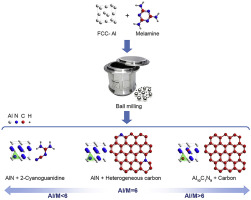 |
| Graphical Abstract: Evolution of the end products as function of Al and N content during ball-milling synthesis of AlN. |
A versatile ball milling process was employed for the synthesis of hexagonal aluminum nitride (h-AlN) through the reaction of metallic aluminum with melamine. A combined experimental and theoretical study was carried out to evaluate the synthesized products. Milling intermediates and products were fully characterized via various techniques including XRD, FTIR, XPS, Raman and TEM. Moreover, a Boltzmann distribution model was proposed to investigate the effect of milling energy and reactant ratios on the thermodynamic stability and the proportion of different milling products. According to the results, the reaction mechanism and milling products were significantly influenced by the reactant ratio. The optimized condition for AlN synthesis was found to be at Al/M molar ratio of 6, where the final products were consisted of nanostructured AlN with average crystallite size of 11 nm and non-crystalline heterogeneous carbon.
Permanent link to this article: https://dannyvanpoucke.be/paperdoped-nitrides-iii-en/
Aug 29 2017
As a computational materials scientist with a main research interest in the ab initio simulation of materials, computational resources are the life-blood of my research. Over the last decade, I have seen my resource usage grow from less than 100.000 CPU hours per year to several million CPU-hours per year. To satisfy this need for computational resources I have to make use of HPC facilities, like the TIER-2 machines available at the Flemish universities and the Flemish TIER-1 supercomputer, currently hosted at KU Leuven. At the international level, computational scientists have access to so called TIER-0 machines, something I no doubt will make use of in the future. Before I continue, let me first explain a little what this TIER-X business actually means.
The TIER-X notation is used to give an indication of the size of the computer/supercomputer indicated. There are 4 sizes:
This is roughly the status of what is available today for Flemish scientists at various levels. With the constantly growing demand for more processing power, the European union, in name of EuroHPC, has decided in march of this year, that Europe will host two Exa-scale computers. These machines will have a peak performance of at least 1 EFLOPS, or 1000 PFLOPS. These machines are expected to be build by 2024-2025. In June, Belgium signed up to EuroHPC as the eighth country participating, in addition, to the initial 7 countries (Germany, France, Spain, Portugal, Italy, Luxemburg and The Netherlands).
This is very good news for all involved in computational research in Flanders. There is the plan to build these machines, there is a deadline, …there just isn’t an idea of what these machines should look like (except: they will be big, massively power consuming and have a target peak performance). To get an idea what users expect of such a machine, Tier-1 and HPC users have been asked to put forward requests/suggestions of what they want.
From my user personal experience, and extrapolating from my own usage I see myself easily using 20 million hours of CPU time each year by the time these Exa-scale machines are build. Leading a computational group would multiply this value. And then we are talking about simple production purpose calculations for “standard” problems.
The claim that an Exa-scale scale machine runs 1000x faster than a peta-scale machine, is not entirely justified, at least not for the software I am generally encountering. As software seldom scales linearly, the speed-gain from Exa-scale machinery mainly comes from the ability to perform many more calculations in parallel. (There are some exceptions which will gain within the single job area, but this type of jobs is limited.) Within my own field, quantum mechanical calculation of the electronic structure of periodic atomic systems, the all required resources tend to grow with growth of the problem size. As such, a larger system (=more atoms) requires more CPU-time, but also more memory. This means that compute nodes with many cores are welcome and desired, but these cores need the associated memory. Doubling the cores would require the memory on a node to be doubled as well. Communication between the nodes should be fast as well, as this will be the main limiting factor on the scaling performance. If all this is implemented well, then the time to solution of a project (not a single calculation) will improve significantly with access to Exa-scale resources. The factor will not be 100x from a Pflops system, but could be much better than 10x. This factor 10 also takes into account that projects will have access to much more demanding calculations as a default (Hybrid functional structure optimization instead of simple density functional theory structure optimization, which is ~1000x cheaper for plane wave methods but is less accurate).
At this scale, parallelism is very important, and implementing this into a program is far from a trivial task. As most physicists/mathematicians/chemists/engineers may have the skills for writing scientifically sound software, we are not computer-scientists and our available time and skills are limited in this regard. For this reason, it will become more important for the HPC-facility to provide parallelization of software as a service. I.e. have a group of highly skilled computer scientists available to assist or even perform this task.
Next to having the best implementation of software available, it should also be possible to get access to these machines. This should not be limited to a happy few through a peer review process which just wastes human research potential. Instead access to these should be a mix of guaranteed access and peer review.
What could an HPC user as myself do to contribute to the success of EuroHPC? This is rather simple, run the machine as a pilot user (I have experience on most of the TIER-2 clusters of Ghent University and both Flemish Tier-1 machines. I successfully crashed the programs I am using by pushing them beyond their limits during pilot testing, and ran into rather unfortunate issues. 🙂 That is the job of a pilot user, use the machine/software in unexpected ways, such that this can be resolved/fixed by the time the bulk of the users get access.) and perform peer review of the lager specialized projects.
Now the only thing left to do is wait. Wait for the Exa-scale supercomputers to be build…7 years to go…about 92 node-days on Breniac…a starting grant…one long weekend of calculations.
For simplicity I use the term CPU to indicate a single compute core, even though technically, nowadays a single CPU will contain multiple cores (desktop/laptop: 2-8 cores, HPC-compute node: 2-20 cores / CPU (or more) ). This to make comparison a bit more easy.
Furthermore, modern computer systems start more and more to rely on GPU performance as well, which is also a possible road toward Exa-scale computing.
Permanent link to this article: https://dannyvanpoucke.be/exa-scale-computing/
Aug 05 2017
 Today is a joyful day, as I am getting married to my lovely girlfriend, my partner in crime, the mother of our son, the stars of my night-sky: my wife.
In February, we silently snuck out and got married (just the two of us and our son). We even had a small honeymoon/pilgrimage to Enschede, the place where it all began. We visited the town and the university campus, reliving old memories of those first days.
Today, we have the ring-ceremony and wedding party to share our happiness with our family and friends. As we are having the celebration at a local castle, Sylvia also designed a special coat of arms for our little family:

Permanent link to this article: https://dannyvanpoucke.be/just-married/
Jul 29 2017
Computational as a third pillar of science (next to experimental and theoretical) is steadily developing in many fields of science. Even some fields you would less expect it, such as sociology or psychology. In other fields such as physics, chemistry or biology it is much more widespread, with people pushing the boundaries of what is possible. Larger facilities provide access to larger problems to tackle. If a computational physicist is asked if larger infrastructures would not become too big, he’ll just shrug and reply: “Don’t worry, we will easily fill it up, even a machine 1000x larger than that.” An example is given by a pair of physicists who recently published their atomic scale study of the HIV-1 virus. Their simulation of a model containing more than 64 million atoms used force fields, making the simulation orders of magnitude cheaper than quantum mechanical calculations. Despite this enormous speedup, their simulation of 1.2 µs out of the life of an HIV-1 virus (actually it was only the outer skin of the virus, the inside was left empty) still took about 150 days on 3880 nodes of 16 cores on the Titan super computer of Oak Ridge National Laboratory (think about 25 512 years on your own computer).
In Flanders, scientist can make use of the TIER-1 facilities provided by the Flemish Super Computer (VSC). The first Tier-1 machine was installed and hosted at Ghent University. At the end of it’s life cycle the new Tier-1 machine (Breniac) was installed and is hosted at KULeuven. Although our Tier-1 supercomputer is rather modest compared to the Oak Ridge supercomputer (The HIV-1 calculation I mentioned earlier would require 1.5 years of full time calculations on the entire machine!) it allows Flemish scientists (including myself) to do things which are not possible on personal desktops or local clusters. I have been lucky, as all my applications for calculation time were successful (granting me between 1.5 and 2.5 million hours of CPU time every year). With the installment of the new supercomputer accounting of the requested resources has become fully integrated and automated. Several commands are available which provide accounting information, of which mam-balance is the most important one, as it tells how much credits are still available. However, if you are running many calculations you may want to know how many resources you are actually asking and using in real-time. For this reason, I wrote a small bash-script that collects the number of requested and used resources for running jobs:
[codesyntax lang="bash" lines="normal" blockstate="collapsed"]
#small script to collect TIER-1 usage and requested resources
#!/bin/bash
echo "(c) dannyvanpoucke.be"
echo "          _____"
echo "          \0.0/"
echo "          ( o )"
echo "           ^-^ "
echo " Collecting Tier-1 requested/used resources: Breniac "
echo "-----------------------------------------------------"

#step one running resources
RCRrt="0"
RCRwt="0"
tnodes="0"
numl=`qstat -n | grep " R " | wc -l`
for (( i=1 ; i<= $numl ; i++ )); do
lin=`qstat -n | grep " R " | head -$i | tail -1`
nodes=`echo $lin | awk '{print $6}'`
tnodes=$( echo "$tnodes + $nodes" | bc )
lin=`echo $lin | sed 's/:/\ /g'`
rth=`echo $lin | awk '{print $13}'`
rtm=`echo $lin | awk '{print $14}'`
rts=`echo $lin | awk '{print $15}'`
wth=`echo $lin | awk '{print $9}'`
wtm=`echo $lin | awk '{print $10}'`
wts=`echo $lin | awk '{print $11}'`

rtuse=$( bc -l << EOF
scale=4
$nodes * (($rth + ( $rtm + ( $rts / 60.0000 ) )/60.0000)/24.00)
EOF
)
wtuse=$( bc -l << EOF
scale=4
$nodes * (($wth + ( $wtm + ( $wts / 60.0000 ) )/60.0000)/24.00)
EOF
)
RCRrt=$( bc -l << EOF
scale=4
$RCRrt + $rtuse
EOF
)
RCRwt=$( bc -l << EOF
scale=4
$RCRwt + $wtuse
EOF
)
done

echo " RESOURCES CURRENTLY RUNNING:"
echo "------------------------------"
echo " Number of running jobs : "$numl" ($tnodes nodes)"
echo " Resources in play (used/request): $RCRrt / $RCRwt nodedays"
echo " "
#step two queued resources

RCQwt="0"
numl=`qstat -n | grep " Q " | wc -l`
for (( i=1 ; i<= $numl ; i++ )); do
lin=`qstat -n | grep " Q " | head -$i | tail -1`
nodes=`echo $lin | awk '{print $6}'`
lin=`echo $lin | sed 's/:/\ /g'`
wth=`echo $lin | awk '{print $9}'`
wtm=`echo $lin | awk '{print $10}'`
wts=`echo $lin | awk '{print $11}'`

wtuse=$( bc -l << EOF
scale=4
$nodes * (($wth + ( $wtm + ( $wts / 60.0000 ) )/60.0000)/24.00)
EOF
)

RCQwt=$( bc -l << EOF
scale=4
$RCQwt + $wtuse
EOF
)
done

echo " RESOURCES CURRENTLY QUEUED:"
echo "------------------------------"
echo " Number of queued jobs : "$numl
echo " Resources requested   : $RCQwt nodedays"
echo " "

#step three used resources in ended jobs
cnt="0"
RCFrt="0"
RCFwt="0"
numl=`qstat | grep " C " | wc -l`
#mam-statement does give the ID's but no further info can be extracted from qstat.
#numl=`mam-statement | grep $project | grep 'UsageRecord' | wc -l`
# list of jobIDs
LST=`qstat | grep " C " | sed 's/\./\ /g' | awk '{print $1}'`
#LST=`mam-statement | grep $project | grep 'UsageRecord' | awk '{print $3}'`

for jobid in `echo $LST`; do
#check if the job actually ran
tst=`qstat -f $jobid | grep 'walltime' | wc -l`
if [ "$tst" == "2" ]; then
nodes=`qstat -f $jobid | grep nodect | awk '{print $3}'`
lin=`qstat -f $jobid | grep 'resources_used.walltime' | awk '{print $3}' | sed 's/:/\ /g'`
rth=`echo $lin | awk '{print $1}'`
rtm=`echo $lin | awk '{print $2}'`
rts=`echo $lin | awk '{print $3}'`
lin=`qstat -f $jobid | grep 'Resource_List.walltime' | awk '{print $3}' | sed 's/:/\ /g'`
wth=`echo $lin | awk '{print $1}'`
wtm=`echo $lin | awk '{print $2}'`
wts=`echo $lin | awk '{print $3}'`

rtuse=$( bc -l << EOF
scale=4
$nodes * (($rth + ( $rtm + ( $rts / 60.0000 ) )/60.0000)/24.00)
EOF
)
wtuse=$( bc -l << EOF
scale=4
$nodes * (($wth + ( $wtm + ( $wts / 60.0000 ) )/60.0000)/24.00)
EOF
)

RCFrt=$( bc -l << EOF
scale=4
$RCFrt + $rtuse
EOF
)
RCFwt=$( bc -l << EOF
scale=4
$RCFwt + $wtuse
EOF
)

else
# if the job didn't run
cnt=$(bc -l << EOF
scale=0
$cnt + 1
EOF
)
fi
done

pct=$( bc -l << EOF
scale=3
 ( $RCFrt / $RCFwt ) * 100.00
EOF
)

#remove the number of not-run jobs
numl=$(bc -l << EOF
scale=0
$numl - $cnt
EOF
)

echo " RESOURCES RECENTLY COMPLETED JOBS:"
echo "-------------------------------------"
echo " Number of jobs not run : "$cnt
echo " Number of compled jobs : "$numl
echo " Resources used   : $RCFrt / $RCFwt nodedays"
echo " This is "$pct" % of the requested resources."
echo " "

# finish with the Balance
mam-balance
[/codesyntax]
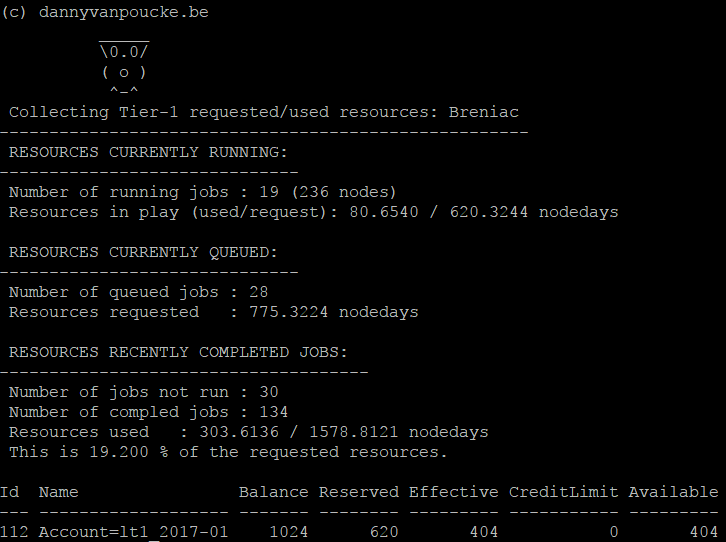
Output of the Bash Script.
Currently, the last part, on the completed jobs, only provides data based on the most recent jobs. Apparently the full qstat information of older jobs is erased. However, it still provides an educated guess of what you will be using for the still queued jobs.
Permanent link to this article: https://dannyvanpoucke.be/pbsbalancecollector-en/
Jun 16 2017
This semester I had several teaching assignments. I was a TA for the course biophysics for the first bachelor biomedical sciences, supervised two 3rd bachelor students physics during their first steps in the realm of computational materials science, and finally, I was responsible for half the course Functional Molecular Modelling for the first Masters Biomedical students (Bioelectronics and Nanotechnology). In this course, I introduce the the students into the basic concepts of classical molecular modelling (quantum modelling is covered by Prof. Wilfried Langenaeker). It starts with a reiteration of some basic concepts from statistics and moves on to cover the canonical ensemble. Things get more interesting with the introduction into Monte-Carlo(MC) and Molecular Dynamics(MD), where I hope to teach the students the basics needed to perform their own MC and MD simulations. This also touches the heart of what this course should cover. If I hear a title like Functional Molecular Modelling, my thoughts move directly to practical applications, developing and implementing models, and performing simulations. This becomes a bit difficult as none of the students have any programming experience or skills.
Luckily there is excel. As the basic algorithms for MC and MD are actually quite simple, this office package can be (ab)used to allow the students to perform very simple simulations. This even without the use of macro’s or any advanced features. Because Excel can also plot the data present in the cells, you immediately see how properties of the simulated system vary during the simulation, and you get direct update of all graphs every time a simulation is run.
It seems I am not the only one who is using excel for MD simulations. In 1995, Fraser and Woodcock even published a paper detailing the use of excel for performing MD simulations on a system of 100 particles. Their MD is a bit more advanced than the setup I used as it made heavy use of macro’s and needed some features to speed things up as much as possible. With the x486 66MHz computers available at that time, the simulations took of the order of hours. Which was impressive, as they served as an example of how computational speed had improved over the years, and compared to the months of supercomputer resources one of the authors had needed 25 years earlier to perform the same thing for his PhD. Nowadays the same excel simulation should only take minutes, while an actual program in Fortran or C may even execute the same thing in a matter of seconds or less.
For the classes and exercises, I made use of a simple 3-atom toy-model with Lennard-Jones interactions. The resulting simulations remain clear allowing their use for educational purposes. In case of MC simulations, a nice added bonus is the fact that excel updates all its fields automatically when a cell is modified. As a result, all random numbers are regenerated and a new simulation can be performed by saving the excel-sheet or just modifying a not-used cell.
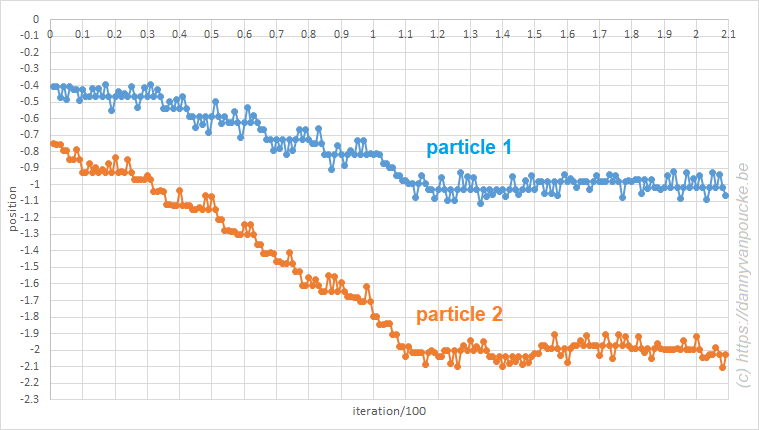
Monte Carlo in excel. A system of three particles on a line, with one particle fixed at 0. All particles interact through a Lennard-Jones potential. The Monte Carlo simulation shows how the particles move toward their equilibrium position.
The simplicity of Newton’s equations of motion make it possible to perform simple MD simulations, and already for a three particle system, you can see how unstable the algorithm is. Implementation of the leap-frog algorithm isn’t much more complex and shows incredible the stability of this algorithm. In the plot of the total energy you can even see how the algorithm fights back to retain stability (the spikes may seem large, but the same setup with a straight forward implementation of Newton’s equation of motion quickly moves to energies of the order of 100).
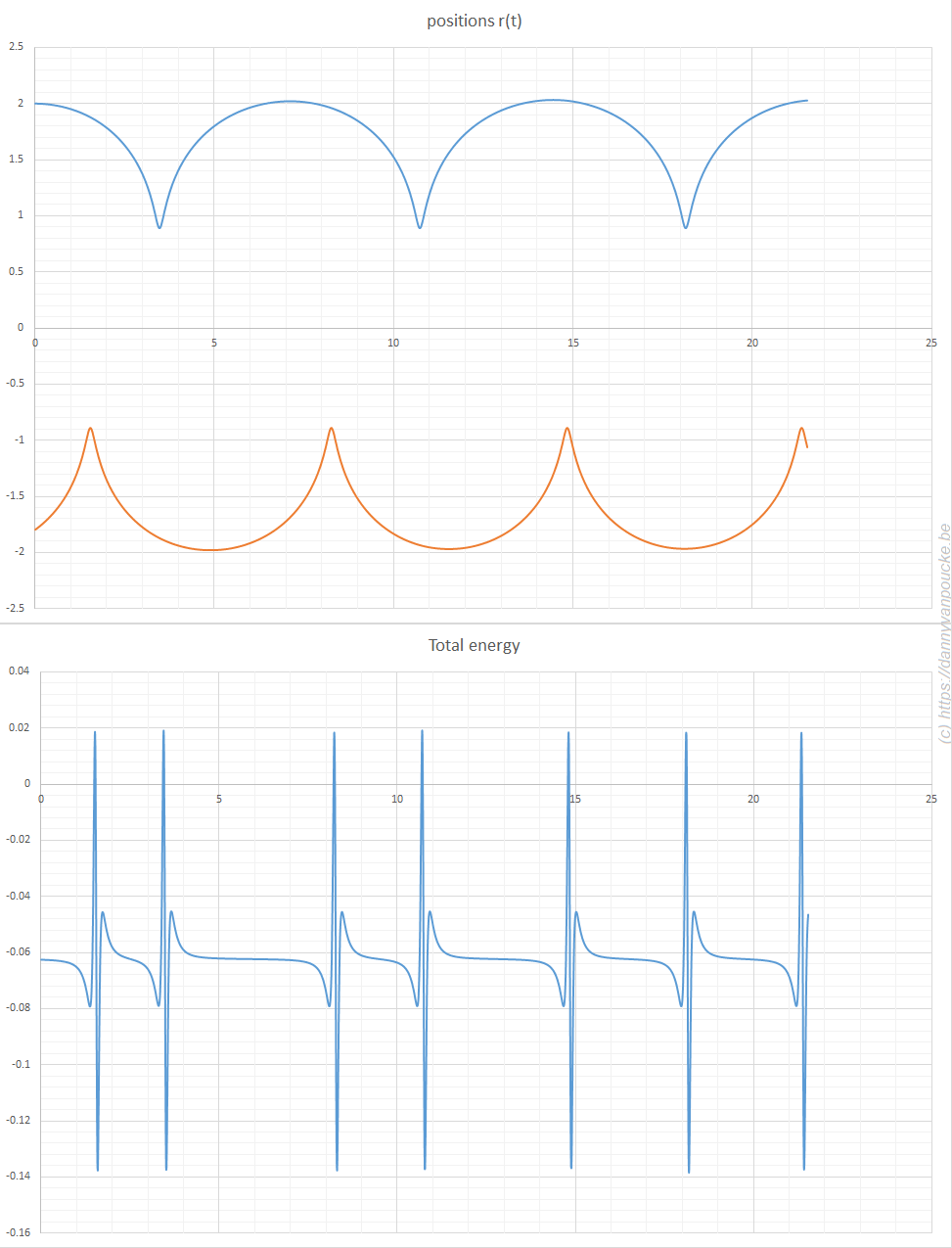
Molecular dynamics in excel. A system of three particles on a line, with one particle fixed at 0. All particles interact through a Lennard-Jones potential. The Molecular dynamics simulation shows how the particles move as time evolves. Their positions are updated using the leap-frog algorithm. The extreme hard nature of the Lennard-Jones potential gives rise to the sharp spikes in the total energy. It is this last aspect which causes the straight forward implementation of Newton’s equations of motion to fail.
Permanent link to this article: https://dannyvanpoucke.be/functional-molecular-modelling-simulating-particles-in-excel/
Jun 09 2017

Black arts of computational materials science.
Just over half a year ago, I mentioned that I presented two computational materials science related projects for the third bachelor physics students at the UHasselt. Both projects ended up being chosen by a bachelor student, so I had the pleasure of guiding two eager young minds in their first steps into the world of computational materials science. They worked very hard, cursed their machine or code (as any good computational scientist should do once in a while, just to make sure that he/she is still at the forefront of science) and survived. They actually did quite a bit more than “just surviving”, they grew as scientists and they grew in self-confidence…given time I believe they may even thrive within this field of research.
One week ago, they presented their results in a final presentation for their classmates and supervisors. The self-confidence of Giel, and the clarity of his story was impressive. Giel has a knack for storytelling in (a true Pan Narrans as Terry Pratchett would praise him). His report included an introduction to various topics of solid state physics and computational materials science in which you never notice how complicated the topic actually is. He just takes you along for the ride, and the story unfolds in a very natural fashion. This shows how well he understands what he is writing about.
This, in no way means his project was simple or easy. Quite soon, at the start of his project Giel actually ran into a previously unknown VASP bug. He had to play with spin-configurations of defects and of course bumped into a hand full of rookie mistakes which he only made once *thumbs-up*. (I could have warned him for them, but I believe people learn more if they bump their heads themselves. This project provided the perfect opportunity to do so in a safe environment. 😎 ) His end report was impressive and his results on the Ge-defect in diamond are of very good quality.
The second project was brought to a successful completion by Asja. This very eager student actually had to learn how to program in fortran before he could even start. He had to implement code to calculate partial phonon densities with the existing HIVE code. Along the way he also discovered some minor bugs (Thank you very much 🙂 ) and crashed into a rather unexpected hard one near the end of the project. For some time, things looked very bleak indeed: the partial density of equivalent atoms was different, and the sum of all partial densities did not sum to the total density. As a result there grew some doubts if it would be possible to even fulfill the goal of the project. Luckily, Asja never gave up and stayed positive, and after half a day of debugging on my part the culprit was found (in my part of the code as well). Fixing this he quickly started torturing his own laptop calculating partial phonon densities of state for Metal-organic frameworks and later-on also the Ge-defect in diamond, with data provided by Giel. Also these results are very promising and will require some further digging, but they will definitely be very interesting.
For me, it has been an interesting experience, and I count myself lucky with these two brave and very committed students. I wish them all the best of luck for the future, and maybe we meet again.
Permanent link to this article: https://dannyvanpoucke.be/bachelor-projects-completed/
Jun 07 2017
Last Friday, the HPC infrastructure in Flanders got celebrated by the VSC user day. Being one of the Tier-1 supercomputer users at UHasselt, I was asked if I could present a poster at the meeting, showcasing the things I do here. Although I was very interested in this event, educational obligations (the presentations of the bachelor projects, on which I will post later) prevented me from attending the meeting.
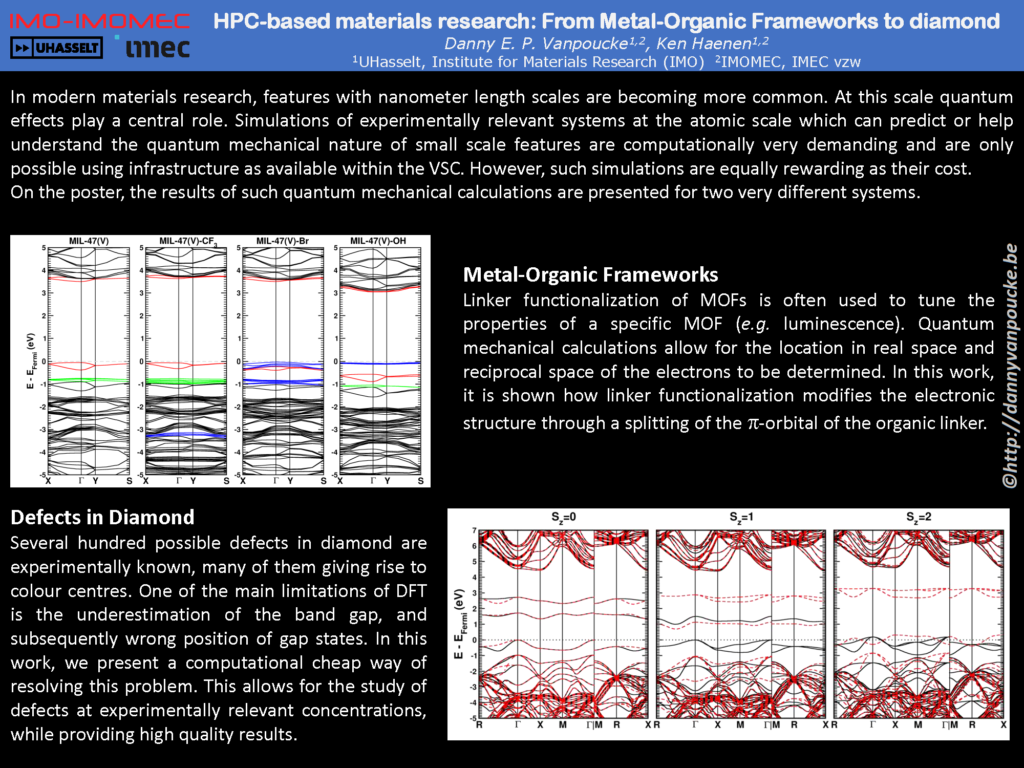
As means of a compromise, I created a poster for the meeting which Geert Jan Bex, our local VSC/HPC support team, would be so nice to put up at the event. The poster session was preceded by a set of 1-minute presentations of the posters, for which a slide had to be made. As I could not be physically present, I provided the organizers a slide which contained a short description that could be used as the 1-minute presentation. Unfortunately, things got a little mixed up, as Geert Jan accidentally printed this slide as the poster (which gave rise to some difficulties in the printing process 🙄 ). So for those who might have had an interest in the actual poster, let me put it up here:

This poster presents my work on linker functionalisation of the MIL-47, which got recently published in the Journal of physical chemistry C, and the diamond work on the C-vacancy, which is currently submitted. Clicking on the poster above will provide you the full size image. The 1-minute slide presentation, which erroneously got printed as poster:
Permanent link to this article: https://dannyvanpoucke.be/vsc-user-day-2017-the-poster-edition/
May 09 2017
With a recent transfer of this website to a new server, I was able to move it more or less entirely into the HTTPS domain. The main reason for doing this is the recent hobby of Google (and chrome as it’s extension) to target HTTP websites to indicate them as insecure [1,2,3]. The transfer from HTTP to HTTPS provides some security with regard to Man-In-The-middle attacks (or for those with the background in quantum information and quantum cryptography: it protects Alice and Bob from Eve…). It unfortunately will not protect my website from being hacked, nor you if I would include “evil” scripts into a page or post. 😈
Those who are interested in the “security” of this website may notice some pages are not yet labeled as secure. The origin lies in the sitemeter used to measure traffic. As it does not allow for an HTTPS connection to the used script. Other than that everything on the pages should be over HTTPS. The sole exceptions are some of the posts, which may still be using the HTTP version of the CSS style sheets and javascript scripts used to securely hide my email. If you notice something like this, feel free to put it in a comment under the post, and I’ll fix it as soon as possible.).
Permanent link to this article: https://dannyvanpoucke.be/improved-security-https/
Apr 28 2017
| Authors: | Seyyed Amin Rounaghi, Danny E.P. Vanpoucke, Hossein Eshghi, Sergio Scudino, Elaheh Esmaeili, Steffen Oswald and Jürgen Eckert |
| Journal: | Phys. Chem. Chem. Phys. 19, 12414-12424 (2017) |
| doi: | 10.1039/C7CP00998D |
| IF(2017): | 3.906 |
| export: | bibtex |
| pdf: | <Phys.Chem.Chem.Phys.> |
Nowadays, the development of highly efficient routes for the low cost synthesis of nitrides is greatly growing. Mechanochemical synthesis is one of those promising techniques which is conventionally employed for the synthesis of nitrides by long term milling of metallic elements under pressurized N2 or NH3 atmosphere (A. Calka and J. I. Nikolov, Nanostruct. Mater., 1995, 6, 409-412). In the present study, we describe a versatile, room-temperature and low cost mechanochemical process for the synthesis of nanostructured metal nitrides (MNs), carbonitrides (MCNs) and carbon nitride (CNx). Based on this technique, melamine as a solid nitrogen-containing organic compound (SNCOC) is ball milled with four different metal powders (Al, Ti, Cr and V) to produce nanostructured AlN, TiCxN1-x, CrCxN1-x, and VCxN1-x (x~0.05). Both theoretical and experimental techniques are implemented to determine the reaction intermediates, products, by-products and finally, the mechanism underling this synthetic route. According to the results, melamine is polymerized in the presence of metallic elements at intermediate stages of the milling process, leading to the formation of a carbon nitride network. The CNx phase subsequently reacts with the metallic precursors to form MN, MCN or even MCN-CNx nano-composites depending on the defect formation energy and thermodynamic stability of the corresponding metal nitride, carbide and C/N co-doped structures.
Permanent link to this article: https://dannyvanpoucke.be/doped-nitrides-ii-en/
Mar 30 2017
| Authors: | Danny E. P. Vanpoucke |
| Journal: | J. Phys. Chem. C 121(14), 8014-8022 (2017) |
| doi: | 10.1021/acs.jpcc.7b01491 |
| IF(2017): | 4.484 |
| export: | bibtex |
| pdf: | <J.Phys.Chem.C> |
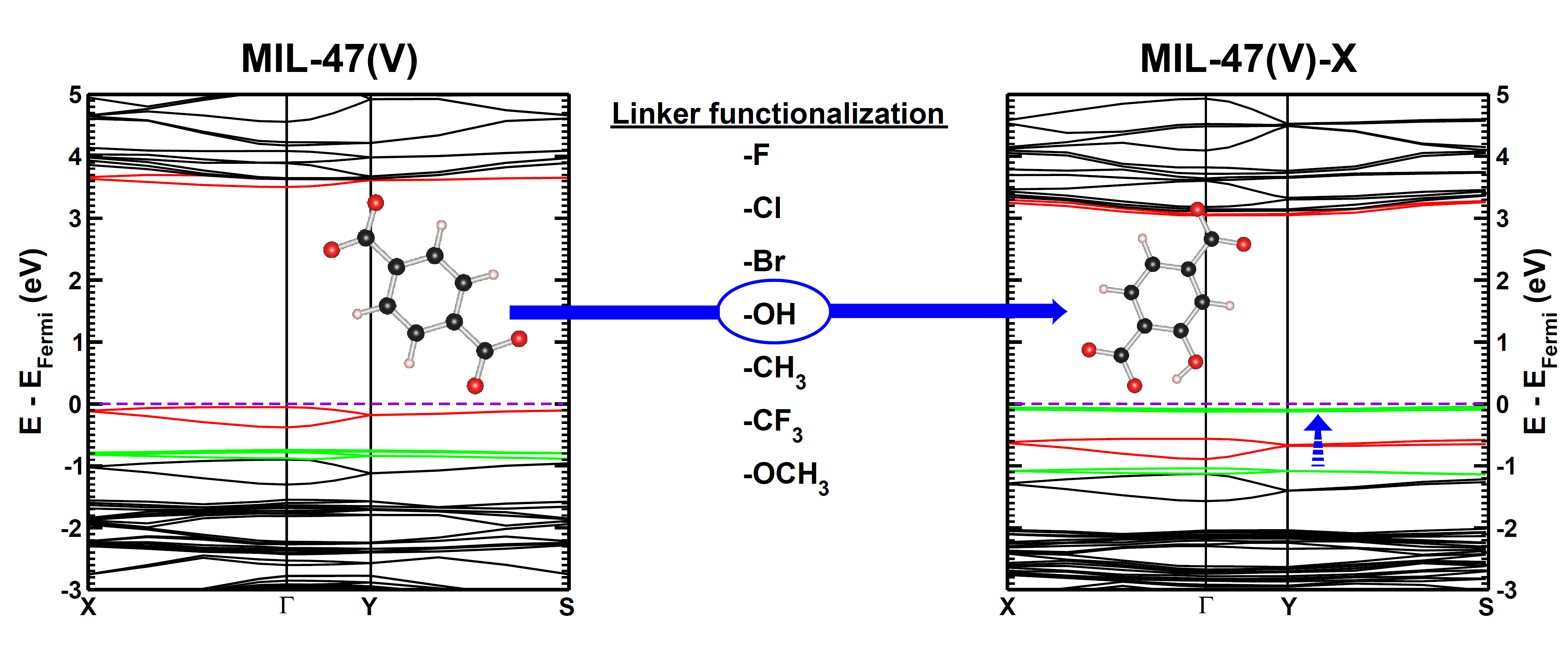 |
| Graphical Abstract: Evolution of the electronic band structure of MIL-47(V) upon OH-functionalization of the BDC linker. The π-orbital of the BDC linker splits upon functionalisation, and the split-off π-band moves up into the band gap, effectively reducing the latter. |
Metal–organic frameworks (MOFs) have gained much interest due to their intrinsic tunable nature. In this work, we study how linker functionalization modifies the electronic structure of the host MOF, more specifically, the MIL-47(V)-R (R = −F, −Cl, −Br, −OH, −CH3, −CF3, and −OCH3). It is shown that the presence of a functional group leads to a splitting of the π orbital on the linker. Moreover, the upward shift of the split-off π-band correlates well with the electron-withdrawing/donating nature of the functional groups. For halide functional groups the presence of lone-pair back-donation is corroborated by calculated Hirshfeld-I charges. In the case of the ferromagnetic configuration of the host MIL-47(V+IV) material a half-metal to insulator transition is noted for the −Br, −OCH3, and −OH functional groups, while for the antiferromagnetic configuration only the hydroxy group results in an effective reduction of the band gap.
Permanent link to this article: https://dannyvanpoucke.be/mof-mil47-linkerfunct-en/